Who are your spiritual heroes?

As has been my tradition, every sermon that I preach will be posted here. This sermon, Who are your spiritual heroes, was given at Waverley Temple Salvation Army on Sunday 18 August, 2013. The Bible reading was Hebrews 11:29-12:2.

Who are your faith heroes? In the bible reading today, we’ve heard a few of the faith heroes that were of importance to the faith community that this epistle was addressed to. We’ve heard of Moses and of Joshua and Rahab. We’ve heard of Gideon, Barak, Samson and Jephthah – Judges of the early Hebrew tribes, and of David, the king, and Samuel, the prophet. We’ve heard all their actions attributed to their faith – by Faith, these great people did these things. These are people that they hold in high esteem in their faith, because of the things that they have done. Continue reading “Who are your spiritual heroes?”

An open letter to Tony Abbott

Dear Tony,

Opposition Leader Tony Abbott (16)
Opposition Leader Tony Abbott (16) (Photo credit: Troy Constable Photography™)

I realise that you’re in the midst of a very busy election campaign, however I feel like I need to bring some things to your attention that need your swift and decisive action.

Now I know you’re a man who likes to be portrayed as Australia’s next action hero, what with the bike riding, budgie smugglers, and running in the city 2 surf, so I’m sure you’ll be able to take the quick and decisive action needed on this issue.

The issue at hand is your language. Now, many will say that perhaps I’m overreacting, but as a voter who hasn’t completely made up his mind yet, I feel like you need to know this information.

Firstly, calling asylum seekers “illegals” is incorrect, you know this, and have been pulled up on it many times. Stop it.

Secondly, and probably the most important thing, please engage your brain before you open your mouth. I have to assume that you are, in fact, quite smart, or you wouldn’t have got as far in politics as you have. However, in recent days, your brain seems to have been on holiday when you’ve been making comments to the media.

For example, your “suppository of wisdom” comment. Now, I know you meant to say “repository” and everyone has little slips of the tongue now and then, but if we are too consider you to be a serious prime ministerial candidate, then we’re need to hold you to a higher level, otherwise we’ll end up with a George W. Bush style leader, whose gaffes are remembered more than what he actually did while in office.

Another example is saying that one of your female candidates has “sex appeal.” Tony, we live in a modern age, where women are seen to have the same opportunities as men, however there are many times when discriminatory remarks are made that while thought to put women up, they actually drag them down. Saying that a female has sex appeal says that we should vote for them based on looks, rather than any of the values that we would hold out male politicians to – hard work, telling the truth, fighting for the values we hold dear. It puts in a discriminatory wedge that devalues all female politicians. In order to get away with this, I have a brilliant idea. Before you make a comment about any female candidate, think, “would I say this about Joe Hockey?” If not, then keep it in your head.

You may think it petty, but your language is very important, as it shows what sort of prime minister you will be – one who builds up our great country, or one who drags it through the mud of derision and being the butt of all jokes for the next three years.

Yours sincerely,

Ben Clapton

What now for asylum seekers?

A couple of nights ago, I attended an event that looked at the issue of asylum seekers, and where to now. The event was very well attended – they were expecting about 30 people, but instead had about 100.
One of the big things I took out of this was an understanding of the two main issues in asylum seeker policy – that of fairness, and of standards.
Continue reading “What now for asylum seekers?”

A shameful day… but what else?

Yesterday, Kevin Rudd announced his new asylum seeker policy, which included as a major point the change that no asylum seeker arriving by boat would be settled in Australia, but instead they would be sent to Papua New Guinea, processed by the PNG Government, and settled in PNG. Another announcement today saw an announcement that the Manus Island Detention Centre would be redeveloped to increase capacity to 3000.

All this from the Prime Minister who warned the Labor party against a lurch to the right on asylum seeker policy. I can only assume that Kevin Rudd meant that instead of a lurch to the right, you should jump so far past the right that we can’t even see the right.

There will be many articles written on why this new policy is bad. Here’s one looking at the numbers of why PNG is not a good solution. But it’s no use to just proclaim the policy bad. In order to fully participate in the debate, an alternative solution needs to be presented as well. This solution needs to not only be shaped on Australian values, but it must also address the issues that this new policy aims to address.

While the Asylum Seeker issue worldwide is a non-issue, here in Australia it is a major part of the political landscape. We need to find a new solution. So I went to look at what other countries do to process their Asylum Seekers. Continue reading “A shameful day… but what else?”

The Requirements of the Lord

As has been my tradition, every sermon that I preach will be posted here. This sermon, The Requirements of the Lord, was given at Mornington Sanctuary Salvation Army on Sunday 5 May, 2013. The Bible reading was Micah 6:1-8. It was recorded, and is available for podcast download through iTunes or directly.

So I’m going to ask a question, and as a bit of warning, If you put your hand up I am going to ask that you prove yourself and answer it – this is not a hypothetical question. So, Who is able to name all ten of the Ten Commandments? No-one? I think we’ve got a bit of work to do here. Ok, so how about something a bit easier – what book and chapter is it found in? Did you know that it’s actually found in two places – in Exodus 20 and Deuteronomy 5. Anyway, here are the 10 commandments.

  1. You shall have no other gods before me
  2. You shall not make for yourself a carved image, or any likeness of anything that is in heaven above, or that is in the earth beneath, or that is in the water underneath the earth. You shall not bow down to them or serve them
  3. You shall not take the name of the Lord your God in vain.
  4. Remember the Sabbath day, to keep it holy.
  5. Honor your father and mother.
  6. You shall not murder.
  7. You shall not commit adultery.
  8. You shall not steal.
  9. You shall not bear false witness against your neighbour.
  10. You shall not covet your neighbour’s house.

And then it goes on to list a few other things that you shall not covet.

What do you notice about the 10 commandments? There’s a lot of “shall nots”! In the New Living Translation of the bible, they actually translate the phrase as “You Must Not” and it appears 10 times in their full text of the ten commandments.

Now, I don’t know about you, but for me I find it hard to do something when I am told that I “must” do it, even if I think it’s the right thing to do. I would rather do it my own way, and discover the mistakes myself.

When we’re told that we’re not allowed to do something, or that we shouldn’t do something, it often makes us want to do it more. Tell a child not to touch the kettle because it’s hot, and they’ll want to touch it even more. Tell a teenager that they’re not allowed to go out, and sure as anything they’ll find a way to get out.

god people usOk, let’s try something different? What are the two greatest commandments? We read about them in Matthew 22:34-40.

Hearing that Jesus had silenced the Sadducees, the Pharisees got together. One of them, an expert in the law, tested him with this question: “Teacher, which is the greatest commandment in the Law?”

Jesus replied: “’Love the Lord your God with all your heart and with all your soul and with all your mind.’ This is the first and greatest commandment. And the second is like it: ‘Love your neighbour as yourself.’ All the Law and the Prophets hang on these two commandments.

As a former Anglican, these two commandments are a lot easier to remember, as they are read in 90% of the Sunday services (the other 10% they read out the full 10 commandments). But they are still easy to remember

They are also easy to apply – Love God, Love Others, Love yourself.

Micah 6 – how have I burdened you?

In Micah 6, the Lord asks his people what he has done to them to burden them. Takes place in a metaphorical court case argument. He asks how he burdened them, and follows that with an account of salvation – He brought them out of Egypt, redeemed them from slavery, highlights the stories of Moses, Aaron and Miriam, Balak and Balaam, and their journey from Shittim to Gilgal.

The Lord has done many wonderful things for us – most of all, he sent Jesus to redeem us from our sin, so that we may live in relationship with him. Yet we often still turn Christianity into a burden. You must not do this. You must not do that. We often do it in the Salvation Army ourselves – When someone asks you about soldiership, what do you say? Well, we’re not allowed to drink, smoke or gamble. Is that really what we want setting us apart – what we’re not allowed to do? We need a paradigm shift – from what we’re not allowed to do, to what we’re required to do.

The Lord Requires us to Do

Now we hear in this passage what the Lord requires of us. Now for some that might be a great word, but the Hebrew word can actually be translated a number of ways. It can also mean to seek, or to ask for, or to practice, study, or seek with application. Basically, what does the Lord ask for us to practice and apply to our daily lives? It’s a much nicer way of putting it, and something that is practical and easy for us to remember, and to put into our daily lives. And there are many who are living out the Micah 6:8 promise who we can turn to for inspiration.

Act Justly

There are a number of examples of people who we can model our lives on who have acted Justly, or fought for justice. You could very well argue that the Salvation Army’s founder, William Booth, was a prime example of someone who acted justly, seeking justice for the oppressed and forgotten of society. Or what about William Wilberforce, who fought against the injustice of slavery.

Martin Luther King, Injustice Abortion The man who comes to my mind when I think about justice is Martin Luther King Jr. The way that he fought against injustice within the American political sphere cemented his place in the American history books, and the hearts of the people. But he deserves our recognition as well, as a Christian man who acted justly. He saw an injustice, and he fought against it in a manner that was completely becoming of a Christian – he did it in a prophetic, non-violent style. What I mean by that is that his protests, and his speeches, presented a vision of what could be, a better way of doing things. In all these things as well, he was non-violent. He did not lift a hand in anger against those who oppressed him, instead he rallied public opinion (as did the organisations that he represented), and forced the politicians hands until there was nothing that they could do but right the wrongs of their nation.

If we were to look at the three men I’ve mentioned, and how they lived their lives, we would see that they have all acted justly through their lives. Yes, on the large-scale, but it is through these men that we can see how to act justly in our own lives – to treat everyone with respect, no matter their background, and to fight for the better treatment of the least, the lost and the last to the best of our abilities.

Love Mercy
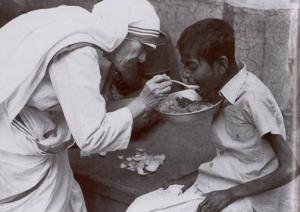
mother-teresa-feedingThe second part of Micah 6:8 has also often been translated as to Love Kindness, and when I think of mercy and kindness, I think of Mother Teresa. This wonderful woman of God showed kindness to everyone she met. She practically showed kindness and mercy to “the hungry, the naked, the homeless, the crippled, the blind, the lepers, all those people who feel unwanted, unloved, uncared for throughout society, people that have become a burden to the society and are shunned by everyone.” Through setting up her order, the Sisters of charity, she founded hospices that cared for the lowest of the low. One of the criticisms leveled against her was that she was friendly to dictators, and while we may say she could have lobbied for justice better, she did show kindness to everyone she met, regardless of their background.

It can be hard, but this is something that is very practical that we can do in our own lives. From things as little as offering your seat on the bus to someone else, or making sure you tip your barista, to inviting your neighbor over for dinner when you know that they’re struggling.

Walk Humbly with your God

When I first started putting together this sermon, I thought that i would put in a joke about how I did a Google search for humble Christians, but it returned no results. How sad it was when i actually did the search, and I got no answers. The thing is that the most well-known Christian figures are anything but humble, due to their being in the spotlight so much. On the flip-side  the truly humble Christians are there doing God’s work often completely unnoticed, and hence don’t show up in Google searches.

I think of one woman from my Church, who is always there willing to work and do whatever is needed, and rarely takes and thanks for the work. I’ve never heard a nasty word from her mouth, instead, the words of someone who is truly humbly walking with God.

Likewise, I think of my good friend, an old retired priest, who continues to serve his church through a prayer and healing ministry, and a wonderful widows and widowers ministry. So humble is his approach, that I’m sure there are many other things that he is doing that i don’t even know about.

2013-04-26 15.49.06

Being humble is probably the thing that we find the hardest as Christians  A lot of that is probably due to us needing to put ourselves apart and put God and others first. It’s not something that we like to do, but it is something that God has asked of us, and as such we need to do something about it.

So tonight, I’m asking you to commit to yourselves living out Micah 6:8, however that looks to you. Commit to acting justly, treating everyone with respect no matter their background. Commit yourself to loving Mercy, showing kindness to everyone. And finally, be humble in your walk with God – make everything you do be to the glory of God, not the glory of you.

Fair Trade, Rainforest Alliance or UTZ: seeing the wood amongst the trees

When you start looking at responsible choices for what you buy, you are faced with a number of options. Fair Trade would be one of the most well known and well advertised, however Rainforest Alliance would be a close second. There are others of course – the coffee that I buy for my everyday coffee is UTZ certified. So what do these terms mean, and should they affect our choices? Let’s look into them, and see what they stand for.

Fairtrade

Fairtrade is about better prices, decent working conditions, local sustainability, and fair terms of trade for farmers and workers in the developing world.

The International Fairtrade Certification Mark

Fairtrade is a worldwide organisation that aims to ensure that those who are producing the product are paid a fair wage for the work that they accomplish. They claim that around 6 million people in developing countries benefit from the Fairtrade system, which provides them with a fair price for the produce that they sell, and also provides for investment in their local community. Fairtrade certification also prohibits child labour.

The way Fairtrade ensures a fair wage is by setting a minimum trade price for a product. This is the minimum price that goods can be sold for. However, this just sets a starting price for negotiations, and allows better quality goods to fetch a premium price.

While most people would recognise Fairtrade most with chocolate and coffee, you can also get Fairtrade certified cotton, fruit and vegetables, jams and spreads, spices, grains, homewares and more.

There is of course some criticism of the Fairtrade system. Some say that it creates a quality problem, where producers get guaranteed a minimum price, even for poor quality products. Others say that the conditions for entry into the program make it restrictive for producers to enter, and receive that price. That said, Fairtrade is still one of the most well known ethical trade systems around today.

Rainforest Alliance

The Rainforest Alliance works to conserve biodiversity and ensure sustainable livelihoods by transforming land-use practices, business practices and consumer behavior.

The Rainforest Alliance Certified seal

The Rainforest Alliance is similar to Fairtrade, however it has more of a focus on the environment. It has five areas of focus for its model: Keeping forests standing, curbing climate change, protecting wildlife, Alleviating poverty, and transforming business practices. As you can see, the focus here is very much on the environment, with some focus also given towards those producing the goods.

In terms of alleviating poverty, Rainforest Alliance claim the “Rainforest Alliance Certified™” seal allows farmers products to reach new markets, negotiate better prices, improve access to credit, and lift themselves and their communities out of poverty, through investing the extra money that they earn in their own community. Being part of a Rainforest Alliance Certified farm also means that employees receive decent wages (which they determine as a minimum of $2 a day), respectable housing and healthcare, and their children having access to education.

Rainforest Alliance boasts some big name supporters. Kraft Coffee is integrating Rainforest Alliance beans into its major brands, Mars has pledged to source its entire cocoa supply from certified sustainable suppliers by 2020 and all of Lipton tea bags will be entirely Rainforest Alliance certified by 2015. The coffee used by McDonald’s McCafe are also Rainforest Alliance certified.

Of course, there are criticisms. It has been described as “Fair trade lite” – allowing companies to be seen as doing something ethical, but at a cheaper price. The Rainforest Alliance certification also doesn’t provide a minimum price for goods, meaning that those who are involved are exposed to the fluctuations of the market. The minimum price for employees is also seen as being set too low. Finally, for things such as coffee, the Rainforest Alliance seal is permitted to be used on products that only contain a mimimum of 30% certified beans, meaning at up to 70% of that coffee does not meet their certification system.

UTZ Certified

UTZ Certified stands for sustainable farming and better opportunities for farmers, their families and our planet. The UTZ program enables farmers to learn better farming methods, improve working conditions and take better care of their children and the environment.

Deutsch: UTZ-Certified Logo

UTZ Certified was originally “Utz Kapeh” which means “Good Coffee” in Mayan. They claim to have 50% of all sustainably certified coffee grown under their label and requirements. Strict monitoring by independent third parties verify that good agricultural practices and management, safe and healthy working conditions, no child labor and protection of the environment are assured throughout the growing and manufacturing processes. They do this by educating farmers on better farming methods; ensuring that working standards set out by the International Labour Organization are upheld; better care for nature through the optimization and reduction of pesticides and using sustainable practices such as recycling and renewable energy; and a strict “No Child Labour” policy, which includes supporting local schools to ensure that children get an education. Through this, UTZ Certified claim that farmers will receive a better crop, which will lead to a better income, while at the same time producing a better environment (through more sustainable and environmentally friendly farming practices), and a better life through supporting the farmers and their families.

Unlike Fairtrade, UTZ Certified doesn’t specify a minimum price for Coffee, and as such Farmers are subject to the volatility of the market. While they claim protection of the environment, UTZ Certified farmers are allowed to use pesticides as long as they are allowed to be used in the major markets (US, Europe and Japan), and that they are applied according to the directions on the label. Another criticism is that UTZ Certified requires workers to be paid in line with national laws – it doesn’t take into consideration if the national laws set the minimum wage too low.

UTZ Certified brands include IKEA, Harris Coffee, and The Coffee Club, which boast 90% of all coffee beans as being from UTZ Certified farms.

Not Labelled?

It should be noted that just because something doesn’t have a label, doesn’t mean that it’s necessarily bad for the environment or the workers who produced it. Dilmah Tea has long refused Fairtrade certification, with the founder claiming that Fairtrade is a “farce” and nothing more than marketing spin. Dilmah has long supported fair remuneration of its workers, and puts 10% of its gross profits into a charitable fund to aid disadvantaged people. I’m currently enjoying some coffee that is completely Australian grown, roasted and owned. Due to the Australian fair trading regulations, you can assume that this coffee is ethically farmed.

In the end, when looking at the benefits and criticisms of all three major labelling systems, it is difficult to pick one as being better than the others. In the end, for me personally, I prefer to choose coffee (and other products) that have a label, as opposed to none. While it doesn’t guarantee everything, it means that at least some effort is being made towards making the farmers lives more sustainable.

Is any life more important than another?

It’s tough to write on such a subject a as the Boston bombings so soon afterwards the event. I want to extend my sympathies to the victims and their families. However, I’ve seen a slightly worrying tend starting to appear on Facebook. Is the images contrasting the Boston bombings with a bombing somewhere in the Middle East, generally passing the question why the Boston bombings received blanket media coverage, while the bombings in the Middle East didn’t receive any.
Is this a legitimate question to ask? Yes. Is the right time to ask it on the very same day? I don’t think so.
By saying that one bombing should have received coverage over another is saying, in effect, that some peoples lives are more important than others. Whether that’s American lives over those of the Middle Eastern lives, or the other way around, either is not right. As a Christian, I believe that we are all made in God’s image, therefore we are all equally important to God.
So as Christians, how should we respond? Firstly, with prayer – for those affected by violence all over the world. Secondly, no matter who is responsible for these acts of terrorism, we need to remember that we cannot respond to violence with violence if we hope to achieve peace. You cannot achieve peace by fighting for it. As such, we need to be promoting a strong nonviolent response. How that will look like will depend on who is found to be responsible for the bombings. However, any response should be one that embraces nonviolent principles.

Turn from evil and do good;
    seek peace and pursue it.

Psalm 34:14
At any time such as this, we need to strengthen our resolve to turn from evil and instead to do good. We need to seek peace and to pursue it in our world. We need to be the voice shouting in the wilderness of the new way, the way of peace, of nonviolence in ways that provide real solutions to the issues at hand.

Advance Australia Fair? (part 3)

In the little sung second verse of the Australian National Anthem, we find the words, For those who come across the seas, we’ve boundless plains to share. However, despite this being part of our national anthem, part of the words that we claim to aspire towards, there is significant evidence that as a nation we are not willing to share the boundless plains that we have. Thankfully, there are also significant programs that are helping to share what we have with those that are new to our nation. Today we’re looking at some of the issues that Asylum Seekers and Refugees face in the area of Language.

Language

Language is a major issue that affects how refugees and asylum seekers are able to integrate into a community. One journal article wrote that “English language proficiency has a direct and obvious impact on the ability of women to settle in Australia and on the length of time that process takes.” The authors of this article found that the majority of participants in a study attributed many of their problems as arising due to their language difficulties. The Department of Immigration and Citizenship does fund an Adult Migrant English Program, providing 510 hours of ESL tuition within the first five years of arrival. However, many have found that these programs are filled with cultural problems, such as mixed classes which make it uncomfortable for those who have come from countries where segregation was the norm.

Another difficulty is that the children often pick up English quicker than the parents. This forms more difficulties between children and parents, where the children know words in English, but are unable to explain it to their parents. This puts further strain on their parents, as they are unable to fully communicate with their children.

As indicated in the last post, the Australian Government’s new “no benefit” policy allows for asylum seekers to be placed in community detention, but they are unable to take part in employment, volunteer work, or to take part in ESL classes. As stated above, this means that those in this situation are unlikely to integrate into the community at any stage. It is a very disturbing policy, that makes the life for those in this situation very difficult.

Advance Australia Fair? (part 2)

In the little sung second verse of the Australian National Anthem, we find the words, For those who come across the seas, we’ve boundless plains to share. However, despite this being part of our national anthem, part of the words that we claim to aspire towards, there is significant evidence that as a nation we are not willing to share the boundless plains that we have. Thankfully, there are also significant programs that are helping to share what we have with those that are new to our nation. Today we’re looking at some of the issues that Asylum Seekers and Refugees face in the area of Employment.

Employment

Employment is one of the major issues and concerns of Asylum Seekers and Refugees, because they do not want to feel like they are a burden on the community. Those who are not permitted to work (because of Temporary Protection Visa’s or conditions placed on their community based detention) find themselves feeling demoralised or despaired at their inability to contribute to Australian Society. Those who are able to seek employment often find discrimination either in the application process, or within the job itself. One Sudanese woman said “At work, the white Australian nurses give me the heaviest and messiest duties to do. Some talk down to me and others just don’t take notice of me and ignore me.”

The Australian Human Rights Commission visited those who were living in community detention. During those visits, they found that “opportunities for self-reliance and meaningful activities are critical to rebuilding resilience amongst asylum seekers, refugees and stateless persons.” Providing meaningful employment can be a very strong way of enabling refugees and asylum seekers to feel a part of their new community.

With this in mind, the Australian Government’s new “No Benefit” policy is incredibly worrying. Basically, what the government can do is give some asylum seekers a temporary protection visa, which does not allow them to work, volunteer, or even take part in ESL classes. This effectively removes them from society, and adds shocking results for their mental health, because not only are they sitting around doing nothing, but they feel bad about having to rely on people and agencies for their survival.


Advance Australia Fair? (part 1)

In the little sung second verse of the Australian National Anthem, we find the words, For those who come across the seas, we’ve boundless plains to share. However, despite this being part of our national anthem, part of the words that we claim to aspire towards, there is significant evidence that as a nation we are not willing to share the boundless plains that we have. Thankfully, there are also significant programs that are helping to share what we have with those that are new to our nation. Over the next few posts, we’ll look at some of the issues that those coming to our country faces in the areas of housing, employment, language and health. We’ll then look at what’s currently happening, particularly in regional areas, and what possible future approaches we can make to share our boundless plains.

Housing

There are a number of issues relating to housing in the resettlement of asylum seekers and refugees. The Brotherhood of St Laurence found that in Shepparton, cheap housing was initially plentiful, it since has become scarce. Housing that was available is often of poor quality, and within a system that is difficult for asylum seekers and refugees to understand. This makes exploitation by real estate agents a common occurrence. There are multiple stories of families with many children being placed in houses with only two or three bedrooms. In a Sudanese community in Colac, the Brotherhood of St Laurence again found a lack of public housing, and difficulties in getting private rentals. Initial settlement costs are another concern, with essential items such as a fridge, beds or blankets being difficult to source from a local Migrant Resource Centre. Where public housing was available, it was often shared amongst a number of families. One woman said “the way we live now, we don’t have plans because we are living together, three families in the one house.” Stress in the area of housing makes it difficult for asylum seekers to feel settled within a community.

Stay tuned for the next post, where we discuss some of the issues that asylum seekers and refugees face in the area of Employment. In the mean time, I’d love to hear any stories that you have about housing difficulties for asylum seekers and refugees, and any thoughts about how we can be more open to sharing the boundless plains of our nation.

References: Taylor, Stanovic and Brotherhood of St Laurence, Refugees and Regional Settlement: Balancing Priorities, 2005