I want you to think back to your high school days. That might be easier for some, or harder. It might bring back pleasant memories, or painful ones. But we all know that in high school, there was generally two groups. There may have been lots of different groups, but in general, they broke down to two main groups – the In crowd, and the out crowd. Which one were you in?
I know that for me, I was most certainly in the out crowd. I wasn’t one of the popular kids. I didn’t fit in. And try as I might to try to get in with the popular crowd, I most certainly never did. I didn’t have the right look, the right speech, the right hair, the right interests, whatever it was that I needed to be part of that crowd, I didn’t have it.
Now, you might see similarities in our society today. There are the in crowd and the out crowd. Those favoured by society, and those despised by society. Those who have it and those who don’t – whatever it is. I’m reminded of a scene from the Simpsons, where Abe Simpsons says “I used to be with it, but then they changed what *it* was. Now what I’m with isn’t *it*, and what’s *it* seems weird and scary to me. It’ll happen to you…” Whatever is it now, will eventually be not it later. Keeping up with it is difficult, unfulfilling and eventually not worth your time. Continue reading “The Christ Crowd”→
Has anyone here ever sculpted anything? Started off with a block of something and made it into something else? You may have heard of the quote falsely attributed to Michelangelo, who apparently said about his statue of David, that he started with a block of marble, and just chipped away anything that didn’t look like David. It’s that simple! You just chip away anything that doesn’t look the way that you wanted it to look.
You may remember a while ago, Liesl got me to bring in something that I had made – Here’s the finished product. This part here, it was once a square piece of huon pine. Then I decided what I wanted to make, and I just removed anything that didn’t look like what I wanted. With that in mind, I want you to watch this video. Continue reading “Holiness drives us out to Mission”→
Have you ever competed in a race?
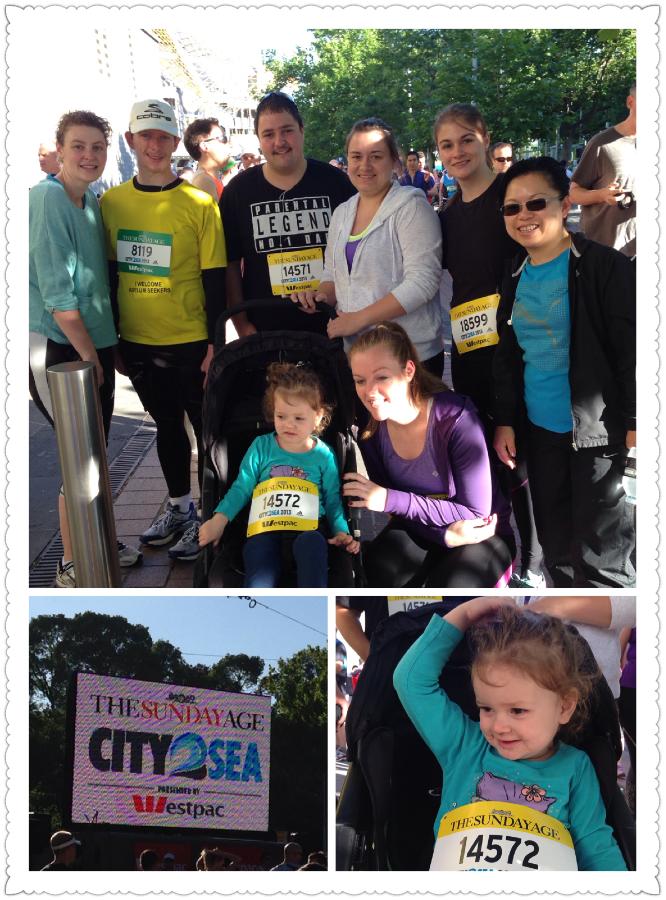
I have, and I can tell you, it’s hard work. I first competed in the Melbourne City2Sea, a 14km fun run, back in 2012. I had taken up running that year, and it was my first real challenge – having never run anything over 10km before. In the lead up to the race, I followed a plan that slowly increased the distance that I was running, so that I was able to complete the race.
Ben and his session mates doing the 2013 City2Sea
The following year, I did it again, following a training plan and getting myself ready for the big day. Then last year, I convinced myself to get out in the rain and run it one more time, this time 15km.
Each year, in order to reach my goal, I needed to prepare. You can’t just wake up on a Sunday morning and go, “I’m going to run from the MCG to St Kilda today. No, you need to put in some preparations beforehand. You need to put in the hard yards, run the kilometers, and get your body ready for the race. Continue reading “Preparing for the Work”→
I believe we all know that I am a bit of a geek… and a geek who loves Star Trek. So I hope you’ll forgive me when I say I’d like to show you a clip from Star Trek. Let me set the scene. Khan has set off the Genesis machine, after a battle with the Enterprise. The Enterprise is damaged, and can’t jump to warp speed to escape. Spock hears this, and heads into the radiation filled warp chamber, and fixes the warp drive, knowing that it will kill him. They escape, then Kirk is called down to the engine room.
“I have been, and always will be, your friend.” It’s possibly one of the most famous of Star Trek quotes. And it got me thinking – that quote kinda sums up how God feels towards us. He has been, and always will be, our friend. And as I was reading this passage, that’s really what I could see – that no matter what, God has been, is, and always will be our friend.
The thing is that we often don’t recognise that. We say that we can’t possibly have God’s love after the things that we’ve done. There are things that I’ve done in my life that I’m deeply ashamed of – surely God can’t love me knowing that I did that.
The passage we heard of today tells of the prophet Jonah taking God’s message to the city of Nineveh. That message was “Forty days more, and Nineveh shall be overthrown!” But what do we know about Nineveh?
Well, we actually know a fair bit. Nineveh was founded by Nimrod, the first on earth to become a mighty warrior. It was condemned by Zephaniah for its arrogance and forcast for destruction. Zephaniah 2:13-15 tells us that Nineveh will be made into “a desolation, a dry waste like the desert,” where “Everyone who passes by it hisses and shakes the fist.” In the book of Nahum, which is all about the destruction of Nineveh, we read Nahum describe the city as the “city of bloodshed, utterly deceitful, full of booty – no end to the plunder!” By all accounts, Nineveh was evil incarnate, and deserved to be destroyed.
And from what we read as well, we can see that people weren’t willing to show God’s love to Nineveh, either. You can see Zephaniah prophesied against it, and Nahum is a whole book celebrating its destruction. When Jonah is told to go and bring a message to Nineveh, he runs away, he doesn’t want to go there. And we read his reason why in chapter 4, “Is not this what I said while I was still in my own country? That is why I fled to Tarshish at the beginning; for I knew that you are a gracious God and merciful, slow to anger and abounding in steadfast love, and ready to relent from punishing.” Jonah didn’t want to go tell Nineveh about God’s message because he knew God wouldn’t destroy them.
You look at that and you can see that we do both things. We put ourselves in boxes, and say that we don’t have the right to deserve God’s love. The things we’ve done are so bad that God couldn’t possibly love us.
But we also do the same thing as Jonah. That person over there, you don’t want him God. Don’t you know what he’s done? He’s a liar, a cheat, he does this, he is that. Surely, you don’t want Him God.
Yet let’s look at how Nineveh, that city of bloodshed, that despised, hated city, who is evil incarnate, is described in the book of Jonah.
1:2 “Go at once to Nineveh, that great city”
3:2 “Get up, go to Nineveh, that great city”
4:11 “And should I not be concerned about Nineveh, that great city”
And you know what – each description there? That’s God speaking to Jonah. God describes Nineveh as a great city. And despite of everything you’ve done, God describes you as a great person.
We can repent and turn back to God
But just because we can be assured that no matter what we do, God loves us, doesn’t mean that we can do anything we want. God still sent a message to Nineveh and that message had a threat of destruction in it. God gave them 40 days, and if nothing happened then Nineveh would be overthrown. So what does Nineveh do? Firstly, the people believed God. The message is shown to us and the first thing we must do is believe.
Secondly, they acted. They proclaimed a fast and everyone put on sackcloth – an act of repentance. When news reaches the King, even himself covered himself in sackcloth and ashes, and says “All shall turn from their evil ways and from the violence that is in their hands. Who knows? God may relent and change his mind; he may turn from his fierce anger, so that we do not perish.”
While we may have done bad things in the past, we are always able to stop, to repent, turn around and go in the direction that God is calling us.
We can live in the love of God
And what is that direction? We read in a few different places what God requires of us. In Micah – the book after Jonah – we read “He has told you, O mortal, what is good: and what does the LORD require of you but to do justice, and to love kindness, and to walk humbly with your God?” In Matthew, we read Jesus tell a Lawyer what the greatest commandments are: “You shall love the Lord your God with all your heart, and with all your soul, and with all your mind.” This is the greatest and first commandment. And a second is like it: ‘You shall love your neighbour as yourself.’”
That’s really what it all boils down to. When we repent, and accept God’s forgiveness, we then start living as Christ calls us to live. To love God humbly, with everything that we have. To love others, showing kindness to them and ensuring that we have justice for all. And to love ourselves – because how can we love others if we do not love ourselves?
Accept God’s love in your life, and offer it to others
So today, I invite you to accept the fact that God loves you. There’s nothing you can do to change that. Nothing you can do will change the fact that God loves you, and loves you so much that he sent his son to die for your sins. Just as Spock sacrificed himself, so that the rest of the ship could live, so Christ sacrificed himself so that all who believe in him will live. It’s Christ, there on the cross, saying “I have been, and always will be your friend.” So how will you respond to God’s love? Will you repent of your sins, and turn to follow Christ and how he’s calling you to live – loving God, loving others, and loving yourself? Will you offer that love to others, knowing that God’s love is available for all?
I invite you to come and respond to God’s love here today. While we do that, we have this song that says “Lord, I come, I confess” – we need to confess to God of our sins. “Without you I fall apart” – we can’t do anything unless we have Christ with us. “You’re the one that guides my heart” – when we’ve confessed, Christ guides our heart into right action.
While we sing, you’re invited to come and confess to God, to come and repent of your sins. Maybe you’re holding onto something that’s stopping you from fully accepting God’s love. Maybe things you’ve said have stopped others from coming to accept God’s love. Maybe you just want to come forward and pray. Someone will come pray with you, or you can bring someone with you if you prefer. But this is your time, to accept the love of God that’s always been there, and turn around and follow Christ.
In the beginning… In the beginning, God… In the beginning, God created… it’s such an Iconic opening sentence, and it holds so much power and understanding for us. And depending on how you want to break it up the first few words can put a whole difference spin on the creation story. In the Beginning, tells us that this story starts at the very beginning – there is nothing more before this. In the Beginning, God, tells us that from that very beginning, there was God. And In the Beginning, God created, tells us about this God – that God is a creative God, one who isn’t content to be there alone, but wants others as well.
Peter Parker gets bitten by a radioactive spiderI watched an interesting video the other day that talked about creation stories of various superheros, and how they reflect who we are, and what we are fearful of, and what we aspire to. For example, he highlighted how in the early mythology of Spiderman, he got his powers from what? Continue reading “Creation Stories”→
As has been my tradition, every sermon that I preach will be posted here. This sermon, The Prince of Peace, was given at The Salvation Army Devonport on Sunday 21 December, 2014, for our Christmas with the Salvos Carols service. The Reading was Isaiah 9:2-7.
I chose the passage for today a few weeks ago. The theme for this Sunday was chosen a few weeks earlier than that. And as I sat down on Tuesday morning, in a coffee shop just down the road, only 24 hours after a siege in another coffee shop in Sydney had started, which ended up costing three people their lives, and changed the lives of countless more, I had to wonder how I could possibly preach on peace, when our peaceful existence has been so shockingly changed.
We live in a world characterised by it’s non-peacefulness
The unfortunate reality is that we live in a world that is characterised by it’s non-peacefulness. Wikipedia currently lists 13 Wars and conflicts currently happening around the world. So far, in 2014, that has resulted in at least 113,804 deaths. Over 100,000 deaths in this year alone. That is almost as many as the average number of deaths per year during the Vietnam War. If you add in those classed as minor skirmishes and conflicts, you have 44 Wars, Conflicts and skirmishes, with pushes it up over 118 thousand deaths in this year alone. Some of this conflicts have been going on since 1948 – the cumulative fatalities caused by these active skirmishes tops 6.5 million. The United Nations High Commission for Refugees reported that in 2013, we had 51.2 million forcibly discplaced people. This is the highest on record. During 2013, conflict and persecution forced an average of 32,200 individuals per day to leave their homes and seek protection elsewhere – up from 23,400 in 2012 and 14,200 in 2011.
But it’s not just armed conflicts that we have to worry about. Life seems to get busier and busier. That business leads to stress, which means that we can’t perform at our best, and can lead to mental and physical health problems. Elsewhere in our society, people are dealing with poverty, drugs, violence, domestic violence and more. All of these things chip away at that ideal, peacefilled existence. Continue reading “Prince of Peace”→
As has been my tradition, every sermon that I preach will be posted here. This sermon, Go All The Way, was given at The Salvation Army Devonport on Sunday 9 November, 2014. The Reading was Mark 10:17-31.
Vince Lombardi (Source: Wikipedia)
Vincent T Lombardi was born in Brooklyn in 1913, to Italian immigrants. His father ran a butcher shop that allowed the family to prosper during the great depression. His family attended Mass every Sunday, which was always followed by dinner with friends, extended family and local clergy. Vincent graduated from the eighth grade in 1928, and then went to Cathedral College of the Immaculate Conception in Brooklyn to become a catholic priest. After four years, he decided not to pursue the priesthood, and instead headed to St Francis Preparatory high school in 1932. He was offered a football scholarship in 1933 to Fordham University, where he was aggressive and spirited on the football field. After leaving university, he tried his hand at Semi-pro football, and as a debt collector, but failed rather quickly. He enrolled in Law, but withdrew after one semester. In 1939, He accepted an assistant coaching job with the St Cecilia High School in New Jersey. By 1942, he was head coach, and in 1943, St Cecilia’s was recognised as the top football team in the nation.
In 1947, he was coach of the Fordham University Freshman teams, and in 1948 an assistant coach of the varsity team.
In 1949, he started as an assistant at West Point, before eventually joining the New York Giants in 1954 to start his NFL Coaching career. He accepted a head coaching role with the Green Bay Packers in 1959, and was named Coach of the year. He turned the team around from its worst record in history in the 1958 season, to a completely sold out season in 1960, and the Packers have sold out every home game since. The Packers won the 1960 NFL Western Conference, and made it to the NFL Championship game against the Philadelphia Eagles, in what would become his only ever championship game loss. He led the Packers to three consecutive NFL Championships in 65, 66 and 67, and win the first two Superbowls in 1966 and 1967, and would eventually have the Superbowl trophy named after him.
Religion was always a constant part of his life. While at St Cecilia, he would attend mass every day, and when he was head coach, he lead his team to Mass before each home game. While coaching the Packers, he would stop at St Willebrord church every day. His faith, and his experiences when growing up, affected his coaching – seeking to break racial prejudice that was rampant in the league, in a time when the Civil Rights movement was only just getting started. He viewed every one of his players the same, saying he “viewed his players as neither black nor white, but Packer green”. He even went as far as telling all Green Bay businesses that if they didn’t accept his black players as well as his white players, then their business would be off limits to the entire team. Continue reading “Go All the Way”→
As has been my tradition, every sermon that I preach will be posted here. This sermon, The Gift of Grace, was given at The Salvation Army Devonport on Sunday 21 September, 2014. The Reading was Matthew 20:1-16.
Have you ever received a gift, but it wasn’t what you were expecting? I’d like to tell you about a guy who was going to college in America. His father had told him that on his graduation, he would get the same present as his brothers – a new car. Now, this wasn’t just any car, but it was the top of the range, Porsche 911
A 2014 Porsche 911 GT3
, with all the trimmings. It was this that kept him going through college. He pushed through every class, he studied hard every night and passed his exams, and eventually came to graduation. He got up on stage, got his paper, and after the ceremony, his dad came over to him and handed him a present. He opened up the present, hoping to see the keys to his new car, but instead, what he found was a bible.
He was furious. He said to his dad, “I’ve spent four years working as hard as I can, to get the grades to let me pass, and all you give me at the end of it is this stupid book!” He marched off home, and threw the book in the corner of his room, never even opening it. He never talked to his father again.
Years later, one of his brothers called him to tell him that his father had died. He’d moved many times since, but he still had that bible. He opened it up, and found a letter, tucked inside. The letter said, “I am, and always will be, proud of you, my son. Your car is waiting for you at the dealership, all you need to do is pick it up.” Continue reading “The Gift of Grace”→
This is part five and the final part in my Vision and Mission sermons at The Salvation Army Devonport. View all of the sermons here. The reading for today was Luke 4:14-30.
What will you fight for?
This speech is one of the most famous quotes of The Salvation Army, and has served for years as a rallying cry. It speaks of the battle that we as an army face – that while there is still one person in need, that we will fight, we will fight to the very end.
Where that end is, we do not know. But, still, we must fight, and fight as if the end is both tomorrow, and in the next millennium.
This quote fits so incredibly well with the words that Jesus spoke in today’s reading. Quoting from Isaiah, this passage speaks of Jesus’ mission, that would shape his mission and ministry from that point in.
Jesus fights for Justice
Jesus returned to Nazareth, to his home town, and went to the Synagogue to read and teach. He found his way to this quote from Isaiah, and declared: “The Spirit of the Lord is upon me, because he has anointed me to bring good news to the poor. He has sent me to proclaim release to the captives, and recovery of sight to the blind, to let the oppressed go free, to proclaim the year of the Lord’s favour.”
These themes that this passage highlights bare particular emphasis in Luke’s gospel, but it should also be noted that this passage is found in Mark as well. But all through Luke’s gospel, we see the themes of justice, inclusiveness and freedom included as a central part of Jesus’ message. Let’s have a quick overview of Luke, to show these themes.
Luke’s birth narrative focusses in on Mary, and includes what is (I believe) the longest monologue by a female in the bible, in what became known as the Magnificat, or the Song of Mary. The first people to see Jesus, besides his parents, were the shepherds, not exactly the most well respected people in the bible, but the ones chosen by God. Following the reading we had today, Jesus begins his ministry, and heals a demoniac, Simon’s mother-in-law (separate people, I’m not saying Simon’s mother-in-law was a demoniac), a leper, a paralytic – the people generally avoided by society. He calls his first disciples, a fisherman and a tax collector, and teaches on the plain giving praise to the poor, hungry and sorrowful, and declares love for all as what is expected. There’s more healings of women in Luke’s gospel than in the others, and it’s in Luke’s gospel that we hear that there were a number of women who followed Jesus in the same way as the 12 apostles did.
More and more, all the way through, these themes are realised in Luke’s gospel, even through to it being the women who first see Jesus after he had risen.
Jesus is here to bring good news to the poor, to release the captives, make the blind see, and to free the oppressed, declaring the year of God’s favour. Jesus is fighting for Justice, so that all may live in the kingdom of God.
The Salvation Army fights for Justice
Similarly, The Salvation Army has had a long history of fighting for justice. Now, I just want to first clarify that there are two aspects here: Social Action and Social Advocacy. Let’s put it like this: Social action is applying first aid when we see someone fall over and get injured. Social Advocacy is seeing that multiple people have fallen over in that same place, and campaigning to make changes so that others won’t fall at the same place. Social action is meeting a person’s immediate needs, and social advocacy is ensuring that people won’t need our social action again. Both are important, and both are necessary.
The Salvation Army has had a long history and is well recognised for meeting someone’s immediate needs. But we also have a long history of campaigning for changes in society.
In 1885, The Salvation Army, by way of the Founder’s son, Bramwell Booth, was involved in what would become known as The Maiden Tribute crisis, where W.T. Stead, an English publicist and editor of the Pall Mall Gazette, devised a scheme to purchase a 13-year old girl under the assumption that she would get sold into prostitution, but was instead whisked away to a Salvation Army home in France. The corresponding story written by Stead caused so much hysteria in England that the UK Parliament was forced to raise the age of consent from 13 to 16, as they understood that opposition to the bill meant denying that child prostitution existed, but it was also condoning it.
In the 1890s, William Booth saw that many poor people were developing the fatal disease, “Phossy Jaw”, due to their working in factories producing matches with Yellow Phosphorus. Booth sought to show that matches could be produced safely and at a profit using Red Phosphorus, a process that had been invented back in 1855 by Swedish Chemists. Through providing the workers decent living wages, and campaigning to get grocers and shopkeepers to stock only safety matches, they were able to close their factory in 1901, having forced other factories to improve their working conditions and wages, and use red phosphorus exclusively.
Even today, The Salvation Army is fighting hard for justice in our world, taking a lead with Stop the Traffik, an international campaign to end human trafficking, and also playing a large part in the Fair Trade movement, with many corps moving exclusively to Fair Trade tea and coffee, and the Salvos in PNG producing a coffee that follows fair trade principles of a fair price for the farmers who produce the coffee beans.
We must fight for justice.
In the same way, we as a church, as well as ourselves individually, must fight for justice. Through our Doorways program, we are fighting to stop generational poverty. No longer is giving food enough, but instead we must be looking for ways to help get families out of the poverty cycle. Through our Doorways2Parenting, we are giving skills to parents that will help them to be better parents, which in turn models those parenting skills to their children.
There are many issues of injustice that we can fight for today. Slavery still exists in this world – not just in poor, third world countries, but here in Australia as well. Sexual Slavery is one of the highest forms of slavery in our modern world, and women from all over the world are trafficked and forced to take part in prostitution, pornorgraphy, and other degrading activities. The Stop The Traffik campaign aims to highlight the issue of slavery and human trafficking, with the aim of one day stopping this vile practice.
A lot of our food and clothing is produced in third world countries, where many workers are exploited, and not paid a decent living wage. There are a variety of different certification systems around, such as Fair Trade, Rainforest Alliance, or UTZ certification, that enable us to be sure that the products we are buying have been ethically produced, and the source producers have received a decent wage for their product. Certified Tea, Coffee, and chocolate is becoming more and more widespread – for example, the coffee at McDonald’s is Rainforest Alliance certified, and Nestlé have announced that they are on track to have 100% of their chocolate products being Fair Trade certified by the end of 2015.
Domestic Violence is a major issue in our society, and one that we must stand up to wherever we see it. While most people think of it in terms of Physical Violence, it can occur in many different forms, be it physical, financial, emotional, psychological, or spiritual abuse. Whenever we see something happening, we have to stand up and say, “No, that’s not how we do it here.” We can support initiatives such as White Ribbon Day, which aims to stop violence against women – which is the predominant form of domestic violence – by encouraging men to swear to never commit violence against women, or to stay silent when they witness violence.
Homelessness is still a major issue in our society, with governments seeming to not want to act on the issue. There are many differing programs around, but one of the best things that we can do is to write to our politicians, at a National, State and Local level, and ask them to take this issue seriously. Governments in the US are beginning to realise that by providing houses for the homeless, they can actually reduce the cost of healthcare and other service costs more than what it costs to house them. The sooner our government realises this, and begins to provide affordable accommodation for the homeless, the sooner we will be able to see a noticeable change in our society.
The Australian Government is continuing to push it’s harsh line of border protection, but at the same time trampling on long standing agreements contained within the United Nations Refugee Convetion, as well as Human Rights conventions, and our duty of care for children. There are lots of organisations that are trying to work with the government to present a fairer solution, such as Amnesty International – which you’ve got some of their materials in your sermon notes today – the Australian Churches Refugee Taskforce, the Asylum Seekers Resource Centre, and many more, and we can support their campaigns, as well as writing to politicians, and other actions to encourage our politicians to show the love of the stranger that our faith encourages, and the fair go culture that we believe Australian culture has always had.
At the beginning of my sermon, you heard the words of the founder, in his famous “I’ll Fight” speech, and some modern day responses. As Salvationists, we are called to fight for this world, and whether you identify as a Salvationists or just as a Christian – or even just as a human being – I think we are all called to fight for change in our world. Mahatma Gandhi once said “If we could change ourselves, the tendencies in the world would also change. As a man changes his own nature, so does the attitude of the world change towards him… We need not wait to see what others do.” Or, as it is often simplified to, “Be the change you want to see in the world.” We have the opportunity – not only as a church, but as individuals as well, to fight for change, to fight for the Transformation of our society. So what will you fight for?
While women weep, as they do now, will you fight?
While little children go hungry, as they do now, will you fight?
While men go to prison, in and out, in and out, as they do now, will you fight?
WHile there is a drunkard left, while there is a poor lost girl upon the streets, will you fight?
While there are people seeking asylum, who are forced to live in harsh conditions, will you fight?
While there are farmers producing food for major corporations with massive profits, but don’t have money to feed their own family, will you fight?
While there remains one dark soul without the light of God, will you fight?
This is part two in my Vision and Mission sermons at The Salvation Army Devonport. View all of the sermons here. The reading for today was Luke 19:1-10.
A news story caught my eye recently. A group of kids at a school was a cat stuck up a tree. They saw a cop, and begged him to rescue the cat: “You gotta get the cat! You gotta get the cat!” So the cop dutifully started to climb up the tree to rescue the cat. Except the cat didn’t really want to be rescued, so it jumped a bit higher, and the officer dutifully climbed a bit higher… until he realised that he was stuck. The cop had to call the New York Fire Department to bring a tower ladder and bucket in order to rescue him and the black and white cat. It’s probably a good thing that Zacchaeus didn’t get stuck when Jesus invited himself over for dinner.
When have you been left out?
We continue our series on our vision and mission today, and we’re looking at the first mission intention: Transforming Lives. And I want to ask you whether you remember ever being left out for something. Who was ever the last picked on the sports team? Have you ever been the next person in line when the “Sold Out” sign was put up? Have you ever been dropped from a team?
On the other hand, have you ever been given an opportunity to skip the queue? For example, you’re lining up in the supermarket for the only lane that’s open, and there’s five or six people in front of you. Then an assistant comes and asks if you’d like to move to their lane – how awesome is that! An opportunity to skip the queue.
Zacchaeus – the doubly disadvantaged
It’s really tough to be left out of something, or to be the last one picked. For Zacchaeus, although he was rather influential, he was marginalized both socially and religiously. Firstly, he was short, and society, like today’s society, wants to admire the tall, not the short. You need to be big and strong, not short and weak. But on top of that, Zacchaeus was the Chief Tax Collector. Now, tax collectors – as a whole – were hated amongst the Jews, and seen as being traitors by them, and despised by the Romans they worked for as being Jews. But Zacchaeus wasn’t just a tax collector, he was the chief tax collector. He had a number of tax collectors who worked under him, who would siphon the money back to him, who would then siphon the money up to the Romans, with each one taking their own cut. He was hated by everyone.
So when he wants to go and see this teacher guy who has a habit of loving the unloveable, he knows that no-one in the crowd is going to get out of his way so that he can see. So he decides that the best thing to do is to climb up a tree – which is the sort of activity that a child would do, not some important official (even if no-one respected the important official).
Zacchaeus jumps over every disadvantage that he has, in order to hear or see this teacher guy.
Zacchaeus jumps the queue
This extravagant gesture by Zacchaeus is matched by Jesus, who also acts to overcome Zacchaeus’ double disadvantage. He invites himself over for dinner. He just walks up to the tree, and says “Zacchaeus, what are you doing up there? I’m gonna stay at your place today, so hurry up and get down here.” Now Zacchaeus was over the moon – this incredible teacher, who people wouldn’t even get out of the way to let him see, singled him out and was going to stay at his place.
Now, of course, this got a few people grumpy. I mean, no-one likes being looked over, and there were all these other people there who thought that they should be look at before this “sinner”. Luke doesn’t name this group. It’s just “They.” “All who saw it” were grumbling. “They” – this unnamed group – probably represents the crowd that Jesus is actually trying to teach. Zacchaeus isn’t who Jesus’ teaching was intended for, it was this group.
So what are they offended at? They’re angry that Zacchaeus was included. They’re angry that he jumped the queue. They’re angry that he got the preferential treatment.
It’s so easy to get like that isn’t it? How do you feel if you’re 4th in line, and the teller comes and grabs everyone behind you to go and join a new lane? Or if you’ve been waiting for something, and someone else gets it before you do?
This jumping the queue – that’s what grace is like. And it’s so annoying, isn’t it? We feel like we’ve been putting in the hard yards, and then someone comes along and gets just the same as us. It’s offensive to our sense of entitlement.
But Jesus doesn’t care about that. In one way he’s saying “The Age of Entitlement is over” – but in another, he’s saying “The Age of Entitlement is Here… for everyone.” Jesus acts in radical acceptance of Zacchaeus, and shows him grace. This grace goes before any change that can happen in him. It is only through this grace – that isn’t just available for Zacchaeus, but is available for everyone – that transformation can happen within Zacchaeus.
So what does Zacchaeus do with this gift? See, the gift of grace – while it’s there for all of us to take – is actually an invitation. Once we receive it, we must do something with it. For Zacchaeus, he reconnects with his community. He puts the wrongs he has done right, he gives away half his possessions, and pays back anyone he’s defrauded. So Jesus declares that salvation has come to this house – because of the actions in response to that grace, Zacchaeus is transformed, and is saved. By grace, anyone can be saved – even a rich man who society hates.
We can help others jump the queue
One of our mission priorities is transforming lives. This is described as “Working for personal renewal through Jesus Christ, that touches and integrates the whole person.” For us to do that, we need to show grace to everyone who comes through our door. When we show the radical acceptance that Jesus showed to Zacchaeus, we open the door to allowing radical transformation within people’s lives.
Through every program that we run, we must be inclusive of everyone, no matter what state they come in. Now, sure, we’ve got some women’s groups, and some Men’s groups, but we must be inclusive of all that come along to those groups. Now, I think we do a pretty good job at that, however, we must always be careful to make sure that we measure up to our ideal. I’m sure that the people surrounding Zacchaeus who were grumbling thought that they were pretty good – indeed they thought that Jesus should come to them before going to Zacchaeus. So who are the people that are rejected by society today, and how would we react if they came through our doors one Sunday? How would we react if they wanted to join one of our programs?
Andrew Marr wrote that “The challenge of this story… is not limited to the possible conversion of one person, but it extends to the possible conversion of the whole community.” When we show grace to one person, yes, it opens up the possibility of conversion there. But when we show grace to one person, it opens up the possibility of conversion to the whole community of people that that person influences as well.
Each week, I meet with some of the local pastors around the place. This week just gone, we met at Gateway church, where that church was having a conference with some guest pastors. They had had a rally the night before, and they were sharing stories of people who were healed, people who were converted and so on. And the lead pastor there really stressed that as their church were following what they were called to do, and every other church did what God was calling them to do, that through all of that, we can witness the transformation of our whole community, all across the North West. Each person that is transformed is a witness to that transformation, and in turn has the opportunity to transform others.
We can jump the queue ourselves
The beauty of it is that it all starts with us. The grace of God, which goes before us, which is there before we even start seeking for it, is always there, waiting for us to take it and be transformed.
Grace doesn’t care where you’ve come from. Grace doesn’t care where you’ve been. Grace doesn’t care whether you’ve been here 80 years or you’ve been here 8 minutes. Grace doesn’t care.
But, Grace will be with you wherever you go. Grace will help shape your every actions. And grace can stay with you for the rest of your life. Grace has the ability to transform your life.
If we’re going to transform our community, and transform others lives, we have to be open to allowing grace to transform our own life. I’m going to play a video, and it very basically tells peoples stories that have been transformed by grace. Their lives have been transformed by grace, and yours can as well. And as we are transformed, we can then go out to transform others.
While you listen to that, you might want to ask Jesus to transform your life. Maybe you’re willing to accept that grace that is being offered to you. Maybe, you’ve been guilty of being the others, the crowd that judged and excluded Zacchaeus. Maybe you’re willing to stand today, and say I am going to show the radical, inclusive love that Jesus showed me, and I’m going to live that out in my life.


 I’m reminded of a scene from the Simpsons, where Abe Simpsons says “I used to be with it, but then they changed what *it* was. Now what I’m with isn’t *it*, and what’s *it* seems weird and scary to me. It’ll happen to you…” Whatever is it now, will eventually be not it later. Keeping up with it is difficult, unfulfilling and eventually not worth your time. Continue reading “The Christ Crowd”


 Ben Clapton