

Has anyone here ever sculpted anything? Started off with a block of something and made it into something else? You may have heard of the quote falsely attributed to Michelangelo, who apparently said about his statue of David, that he started with a block of marble, and just chipped away anything that didn’t look like David. It’s that simple! You just chip away anything that doesn’t look the way that you wanted it to look.
You may remember a while ago, Liesl got me to bring in something that I had made –  Here’s the finished product. This part here, it was once a square piece of huon pine. Then I decided what I wanted to make, and I just removed anything that didn’t look like what I wanted. With that in mind, I want you to watch this video. Continue reading “Holiness drives us out to Mission”
Tag: Church
Preparing for the Work
Have you ever competed in a race?
I have, and I can tell you, it’s hard work. I first competed in the Melbourne City2Sea, a 14km fun run, back in 2012. I had taken up running that year, and it was my first real challenge – having never run anything over 10km before. In the lead up to the race, I followed a plan that slowly increased the distance that I was running, so that I was able to complete the race.
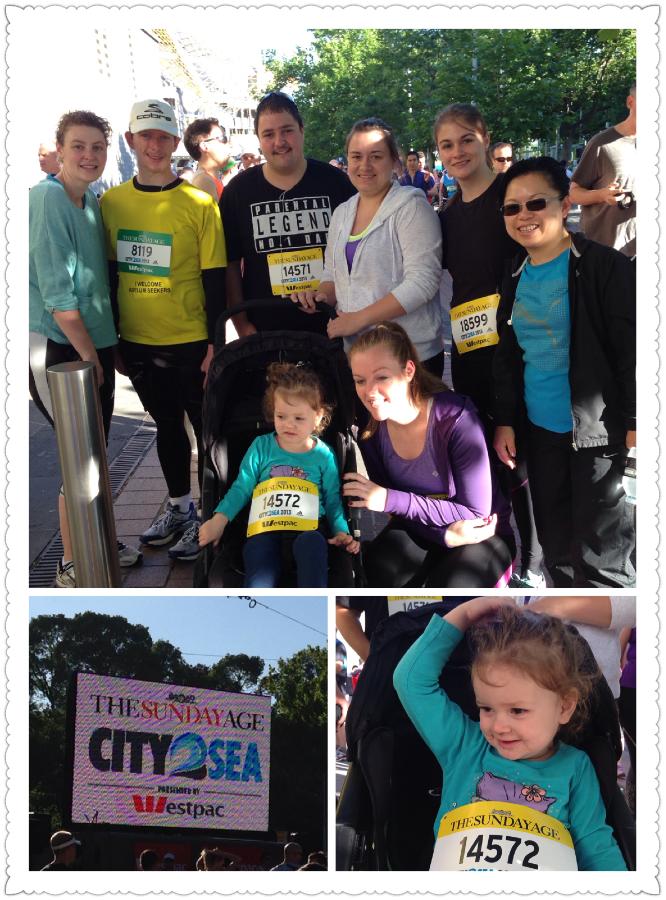
The following year, I did it again, following a training plan and getting myself ready for the big day. Then last year, I convinced myself to get out in the rain and run it one more time, this time 15km.
Each year, in order to reach my goal, I needed to prepare. You can’t just wake up on a Sunday morning and go, “I’m going to run from the MCG to St Kilda today. No, you need to put in some preparations beforehand. You need to put in the hard yards, run the kilometers, and get your body ready for the race. Continue reading “Preparing for the Work”
There is nothing you can do that will stop God from loving you
I believe we all know that I am a bit of a geek… and a geek who loves Star Trek. So I hope you’ll forgive me when I say I’d like to show you a clip from Star Trek. Let me set the scene. Khan has set off the Genesis machine, after a battle with the Enterprise. The Enterprise is damaged, and can’t jump to warp speed to escape. Spock hears this, and heads into the radiation filled warp chamber, and fixes the warp drive, knowing that it will kill him. They escape, then Kirk is called down to the engine room.
 “I have been, and always will be, your friend.” It’s possibly one of the most famous of Star Trek quotes. And it got me thinking – that quote kinda sums up how God feels towards us. He has been, and always will be, our friend. And as I was reading this passage, that’s really what I could see – that no matter what, God has been, is, and always will be our friend.
The thing is that we often don’t recognise that. We say that we can’t possibly have God’s love after the things that we’ve done. There are things that I’ve done in my life that I’m deeply ashamed of – surely God can’t love me knowing that I did that.
The passage we heard of today tells of the prophet Jonah taking God’s message to the city of Nineveh. That message was “Forty days more, and Nineveh shall be overthrown!” But what do we know about Nineveh?
Well, we actually know a fair bit. Nineveh was founded by Nimrod, the first on earth to become a mighty warrior. It was condemned by Zephaniah for its arrogance and forcast for destruction. Zephaniah 2:13-15 tells us that Nineveh will be made into “a desolation, a dry waste like the desert,” where “Everyone who passes by it hisses and shakes the fist.” In the book of Nahum, which is all about the destruction of Nineveh, we read Nahum describe the city as the “city of bloodshed, utterly deceitful, full of booty – no end to the plunder!” By all accounts, Nineveh was evil incarnate, and deserved to be destroyed.
And from what we read as well, we can see that people weren’t willing to show God’s love to Nineveh, either. You can see Zephaniah prophesied against it, and Nahum is a whole book celebrating its destruction. When Jonah is told to go and bring a message to Nineveh, he runs away, he doesn’t want to go there. And we read his reason why in chapter 4, “Is not this what I said while I was still in my own country? That is why I fled to Tarshish at the beginning; for I knew that you are a gracious God and merciful, slow to anger and abounding in steadfast love, and ready to relent from punishing.” Jonah didn’t want to go tell Nineveh about God’s message because he knew God wouldn’t destroy them.
You look at that and you can see that we do both things. We put ourselves in boxes, and say that we don’t have the right to deserve God’s love. The things we’ve done are so bad that God couldn’t possibly love us.
But we also do the same thing as Jonah. That person over there, you don’t want him God. Don’t you know what he’s done? He’s a liar, a cheat, he does this, he is that. Surely, you don’t want Him God.
Yet let’s look at how Nineveh, that city of bloodshed, that despised, hated city, who is evil incarnate, is described in the book of Jonah.
- 1:2 “Go at once to Nineveh, that great city”
- 3:2 “Get up, go to Nineveh, that great city”
- 4:11 “And should I not be concerned about Nineveh, that great city”
And you know what – each description there? That’s God speaking to Jonah. God describes Nineveh as a great city. And despite of everything you’ve done, God describes you as a great person.
We can repent and turn back to God
But just because we can be assured that no matter what we do, God loves us, doesn’t mean that we can do anything we want. God still sent a message to Nineveh and that message had a threat of destruction in it. God gave them 40 days, and if nothing happened then Nineveh would be overthrown. So what does Nineveh do? Firstly, the people believed God. The message is shown to us and the first thing we must do is believe.
Secondly, they acted. They proclaimed a fast and everyone put on sackcloth – an act of repentance. When news reaches the King, even himself covered himself in sackcloth and ashes, and says “All shall turn from their evil ways and from the violence that is in their hands. Who knows? God may relent and change his mind; he may turn from his fierce anger, so that we do not perish.”
While we may have done bad things in the past, we are always able to stop, to repent, turn around and go in the direction that God is calling us.
We can live in the love of God
And what is that direction? We read in a few different places what God requires of us. In Micah – the book after Jonah – we read “He has told you, O mortal, what is good: and what does the LORD require of you but to do justice, and to love kindness, and to walk humbly with your God?” In Matthew, we read Jesus tell a Lawyer what the greatest commandments are: “You shall love the Lord your God with all your heart, and with all your soul, and with all your mind.” This is the greatest and first commandment. And a second is like it: ‘You shall love your neighbour as yourself.’”
That’s really what it all boils down to. When we repent, and accept God’s forgiveness, we then start living as Christ calls us to live. To love God humbly, with everything that we have. To love others, showing kindness to them and ensuring that we have justice for all. And to love ourselves – because how can we love others if we do not love ourselves?
Accept God’s love in your life, and offer it to others
So today, I invite you to accept the fact that God loves you. There’s nothing you can do to change that. Nothing you can do will change the fact that God loves you, and loves you so much that he sent his son to die for your sins. Just as Spock sacrificed himself, so that the rest of the ship could live, so Christ sacrificed himself so that all who believe in him will live. It’s Christ, there on the cross, saying “I have been, and always will be your friend.” So how will you respond to God’s love? Will you repent of your sins, and turn to follow Christ and how he’s calling you to live – loving God, loving others, and loving yourself? Will you offer that love to others, knowing that God’s love is available for all?
I invite you to come and respond to God’s love here today. While we do that, we have this song that says “Lord, I come, I confess” – we need to confess to God of our sins. “Without you I fall apart” – we can’t do anything unless we have Christ with us. “You’re the one that guides my heart” – when we’ve confessed, Christ guides our heart into right action.
While we sing, you’re invited to come and confess to God, to come and repent of your sins. Maybe you’re holding onto something that’s stopping you from fully accepting God’s love. Maybe things you’ve said have stopped others from coming to accept God’s love. Maybe you just want to come forward and pray. Someone will come pray with you, or you can bring someone with you if you prefer. But this is your time, to accept the love of God that’s always been there, and turn around and follow Christ.
Creation Stories
In the beginning… In the beginning, God… In the beginning, God created… it’s such an Iconic opening sentence, and it holds so much power and understanding for us. And depending on how you want to break it up the first few words can put a whole difference spin on the creation story. In the Beginning, tells us that this story starts at the very beginning – there is nothing more before this. In the Beginning, God, tells us that from that very beginning, there was God. And In the Beginning, God created, tells us about this God – that God is a creative God, one who isn’t content to be there alone, but wants others as well.

Go All the Way
As has been my tradition, every sermon that I preach will be posted here. This sermon, Go All The Way, was given at The Salvation Army Devonport on Sunday 9 November, 2014. The Reading was Mark 10:17-31.

Vincent T Lombardi was born in Brooklyn in 1913, to Italian immigrants. His father ran a butcher shop that allowed the family to prosper during the great depression. His family attended Mass every Sunday, which was always followed by dinner with friends, extended family and local clergy. Vincent graduated from the eighth grade in 1928, and then went to Cathedral College of the Immaculate Conception in Brooklyn to become a catholic priest. After four years, he decided not to pursue the priesthood, and instead headed to St Francis Preparatory high school in 1932. He was offered a football scholarship in 1933 to Fordham University, where he was aggressive and spirited on the football field. After leaving university, he tried his hand at Semi-pro football, and as a debt collector, but failed rather quickly. He enrolled in Law, but withdrew after one semester. In 1939, He accepted an assistant coaching job with the St Cecilia High School in New Jersey. By 1942, he was head coach, and in 1943, St Cecilia’s was recognised as the top football team in the nation.
In 1947, he was coach of the Fordham University Freshman teams, and in 1948 an assistant coach of the varsity team.
In 1949, he started as an assistant at West Point, before eventually joining the New York Giants in 1954 to start his NFL Coaching career. He accepted a head coaching role with the Green Bay Packers in 1959, and was named Coach of the year. He turned the team around from its worst record in history in the 1958 season, to a completely sold out season in 1960, and the Packers have sold out every home game since. The Packers won the 1960 NFL Western Conference, and made it to the NFL Championship game against the Philadelphia Eagles, in what would become his only ever championship game loss. He led the Packers to three consecutive NFL Championships in 65, 66 and 67, and win the first two Superbowls in 1966 and 1967, and would eventually have the Superbowl trophy named after him.
Religion was always a constant part of his life. While at St Cecilia, he would attend mass every day, and when he was head coach, he lead his team to Mass before each home game. While coaching the Packers, he would stop at St Willebrord church every day. His faith, and his experiences when growing up, affected his coaching – seeking to break racial prejudice that was rampant in the league, in a time when the Civil Rights movement was only just getting started. He viewed every one of his players the same, saying he “viewed his players as neither black nor white, but Packer green”. He even went as far as telling all Green Bay businesses that if they didn’t accept his black players as well as his white players, then their business would be off limits to the entire team. Continue reading “Go All the Way”
The Gift of Grace
As has been my tradition, every sermon that I preach will be posted here. This sermon, The Gift of Grace, was given at The Salvation Army Devonport on Sunday 21 September, 2014. The Reading was Matthew 20:1-16.
Have you ever received a gift, but it wasn’t what you were expecting? I’d like to tell you about a guy who was going to college in America. His father had told him that on his graduation, he would get the same present as his brothers – a new car. Now, this wasn’t just any car, but it was the top of the range, Porsche 911

, with all the trimmings. It was this that kept him going through college. He pushed through every class, he studied hard every night and passed his exams, and eventually came to graduation. He got up on stage, got his paper, and after the ceremony, his dad came over to him and handed him a present. He opened up the present, hoping to see the keys to his new car, but instead, what he found was a bible.
He was furious. He said to his dad, “I’ve spent four years working as hard as I can, to get the grades to let me pass, and all you give me at the end of it is this stupid book!” He marched off home, and threw the book in the corner of his room, never even opening it. He never talked to his father again.
Years later, one of his brothers called him to tell him that his father had died. He’d moved many times since, but he still had that bible. He opened it up, and found a letter, tucked inside. The letter said, “I am, and always will be, proud of you, my son. Your car is waiting for you at the dealership, all you need to do is pick it up.” Continue reading “The Gift of Grace”
Making Disciples (Vision and Mission Part 4)
This is part four in my Vision and Mission sermons at The Salvation Army Devonport. View all of the sermons here. The reading for today was Luke 6:12-49.
We’re into part four of our series on our Vision and Mission, and today we’re talking about Disciples. Specifically, how we can make disciples, and how we can be disciples. So, I want to start with a bit of a question to get you thinking: What influential moments have you had in your journey of Christian Discipleship? By that I mean, what teaching, studies, reading, actions, retreats, mentors, personal relationships have been most influential in your journey to be a Christian Disciple? Let me share a couple with you.
When I was in year 11, I was still part of the Anglican Church. The Anglican Diocese in Perth was trialling a new idea that (it was hoped) would encourage young people to consider seriously entering into ministry in the church. So a group of us headed down to Rockingham in the Southern Suburbs of Perth, and had a retreat with the Bishop, and a few other priests, looking at ministry and life as a Christian. It was a big success – of the 5 people who went, 3 have moved onto different denominations, one is notionally attending, and one has entered ministry… in a different church. But the reality was that this time was a period that planted the seed of ministry service in my life.
The other influential time for my discipleship was through a retreat community called Chrysalis. This was a three day retreat that looked at various aspects of Christian life and discipleship. While the initial retreat was awesome, what was more influential for me was being involved in the community after that. Serving in various roles, from general support, to musician, to an assistant lay director, and speaking on various topics, helped focus my own Christian life and helped me work through some of the issues that I had in my life.
Both of these retreats had three common aspects that relate to our Christian Discipleship, and we see these aspects coming through in today’s readings. They are calling, Teaching and Doing.
Calling
For both of these retreats, I was invited to attend. My priest put my name forward for me to be invited to attend the ministry exploration retreat by the Bishop, and I was invited to attend Chrysalis by one of my good mates who had attended a retreat before me. We see similar things in Jesus’ calling of the twelve apostles. Traditionally, Disciples sought out a rabbi and asked to follow him and learn from him through question and observation. Jesus flipped this on its head, and sought out and asked Disciples to come and follow him.
We don’t hear about all of the Disciples calling, but earlier in Luke’s gospel, we hear about some of them. Simon was cleaning his nets after fishing on the lake of Gennesaret, when Jesus sat in his boat to start teaching. After catching nothing all night, Jesus told Simon to go out again, where he caught so many fish his nets were beginning to break. Jesus said, “from now on you will be catching people” and Simon left his boats and followed Jesus.
Levi was sitting at the tax booth, and Jesus walked up to him and said “Follow me” so he left everything and followed Jesus.
Both these guys (who would have their names changed – Simon to Peter, and Levi to Matthew), were called by Jesus to come and follow them, and they listened and had their lives changed.
Similarly, a lot of our discipleship has been part of a calling. Maybe you can remember who first invited you to come to church. Or maybe someone invited you to take part in a bible study that ended up changing your life. Or someone invited you to come along on this camp or retreat where you learned something new about God.
Teaching
The next part of my discipleship experiences is teaching. All of my significant moments contain a bit of teaching. My ministry retreat contained teaching from the Bishop, as well as some other priests, as to what ministry can look like – both biblically and in today’s society. Chrysalis contains as the crux of it fourteen talks about different areas of Christian living – Faith, Means of Grace, Marriage and the Single life, and others. In every discipleship moment, there must be an element of teaching, because it is through the teaching that we grow to be more like Christ.
Let’s look at Jesus’ discipleship moment here. He came and stood on a level place, and the multitude from all over the place came to hear him. So he looked up and started speaking. First, in Luke’s version of the Beattitudes, Jesus highlighted the values that he revered, and the values that he didn’t. Blessed are the poor, woe to the rich. Blessed are the hungry, woe to the full.
He then went on to describe a new way of living. This is such a long reading, and each section could quite rightly have a sermon in itself, so I’m not going to get into each section, but through all of this teaching, Jesus shows the crowd a new way of living, that will usher in the Kingdom of God. This kingdom is one of equality, and one of non-violence, where Love is the central theme, not power.
You might like to start thinking about some of your discipleship moments where you’ve experienced some great teaching – and it’s ok, it doesn’t have to be one of my sermons – but while you do that, realise that it doesn’t have to be a single event. While the time’s I’ve illustrated were retreats – that’s what was significant for me. I’ve also enjoyed sharing time over the past few weeks sharing with people who have spent significant time just reading their bibles, and the teaching that they have learnt from that one book alone could well be more than could be gained at a single retreat.
Discipleship isn’t just a one time event. We must be continually learning, accessing the teaching of Jesus, maybe even looking further afield at some of the writings of other great Christian teachers, to get an understanding of what God is telling us, and how he is shaping us into being more of him.
Doing
The final aspect of our discipleship trifecta is the aspect of doing. Now, we don’t earn our faith because of the good works that we do. God loves us, all of us, no matter whether we do great works or not. However, the teaching of Jesus is so rooted in things that we can do, that the only real response to accepting the teaching of Jesus is to say, “Yes Lord, I will do that” – I will live in that way, I will love my enemy, I will turn the other cheek.
I’ve been reading a book recently called Jim and Caspar go to Church. Jim is a former pastor turned author, who employed an Athiest, Caspar, to go with him to various churches and critique their worship services. It’s a fascinating read. Reading through it, I noticed one of Caspar’s common critiques was that the service focussed too much on the inward, and didn’t result in a demonstratable action that could be done. Once the sermon was over, there was no call to action, no “Come do this” or “Go do that”.
Caspar, I feel, hit the nail on the head. Yes, a lot of our faith is an internal, private affair, and that’s how it is. But the result of the love of God that we experience should propel us into action.
James wrote about this in his letter, saying “What good is it, my brothers and sisters, if you say you have faith but do not have works? Can faith save you? If a brother or sister is naked and lacks daily food, and one of you says to them, “Go in peace; keep warm and eat your fill,” and yet you do not supply their bodily needs, what is the good of that? So faith by itself, if it has no works, is dead.” This isn’t to put an emphasis on works above faith, or faith above works. They come out of each other – because we have faith, we do works.
My discipleship moments all had strong elements of doing. My ministry retreat sought to encourage me to go out and explore ministry, to go and experience it and see where God was leading me. Chrysalis had a strong action call at the end of the retreat, to apply Christ’s teachings to your life and to step up into ministry.
When we get out there and apply Christ’s teachings to our lives, we also have the opportunity to learn from what it does to our lives. We grow as disciples through our works.
Conclusion
The wonderful thing about all of this is that we can do it no matter where we are on our journey of discipleship. If you’ve been here for 80 years, God’s still calling you, still teaching you, and still encouraging you to action. If this is your first time here, something or someone has called you to be here, and you have the opportunity to learn from Jesus’ teachings and go apply it to your life. Whether it’s your first day or your 800th, Christ is giving you the opportunity to progress along your journey of discipleship.
And the wonderful thing is that we as a church can support you in that. As individuals, we can invite people to come along, to give them that calling so that they may start the next part of their journey. As a church, we have bible studies, we have classes, we have opportunities to apply that faith into works, so that we can all share in our discipleship journey together. But of course, there is more than one way to skin a cat, and maybe God has put on your heart something that he would like you to do. Maybe Christ is calling you to get back into your bible reading. Maybe the Holy Spirit is leading you towards a retreat, or a bible study, or to share what you’ve experienced with someone else.
Hear God’s call on your life. Learn from the word of God. Go out and do it in community.
Be a Lighthouse (Vision and Mission part 1)
Today marks the start of a bit of a series that I’m going to preach on over the next few weeks. My reasoning for doing this is for a couple of parts. Firstly, I want us to hold a very clear picture in our heads as to who we are. We don’t have a building at the moment, and that’s ok, because the Church isn’t the building – but, at the same time, we’re all getting used to being slightly uncomfortable, and not knowing who we are – or more so, how we can be who we are. Secondly, I want to make sure that when we do get back into our building that we’re ready and raring to go, and that everything we start, everything we do, is coming out of our Vision and Mission.
Now we all know what our vision is, right? To be a lighthouse to the community, so that others can experience the life changing power and freedom found in Jesus. And our Mission is the four mission intentions of The Salvation Army: Transforming Lives, Caring for People, Making Disciples, and Reforming Society. Over the next six weeks (5 of my sermons, plus a Kidzone Sunday next week, because our Kids are a vital part of our church), we’ll look at our vision, and the four aspects of the mission, and the following week, you’ll have an opportunity to share some ideas with me as to how we are doing that, what we could be doing better, and maybe some new ideas that we can look into.
So today, we’re looking at our vision, and I’ve got a bit of a confession to make. When I first heard it, I wasn’t convinced about it. I mean, the message that was in there was great, I just wasn’t certain about the lighthouse part of it. I thought it was just a way to make it relevant to the community – because of the Bluff Lighthouse – with the main intent to be a light to the community. See to me, a Light is something portable, something that will head out into the community. A lighthouse was something static, that didn’t move. I wasn’t convinced. But, now that I think about it, now that I’ve explored it, I believe that there’s no truer representation of our church – and what I believe our church needs to be – than a lighthouse, and I’m going to explore that aspect of our vision today.
What is a lighthouse
So I guess the important thing to think about firstly is what is a lighthouse. As it’s the first thing that you hear in our vision, it’s the thing that people latch onto. If someone was to come up to you on the street and ask what The Salvation Army Devonport is all about, you might say “we’re trying to be a lighthouse to the community”. So we need to know what that really means to us.
It is a central point for people to look for
The first thing that I think about when I think about a lighthouse is that it’s a central point for people to look for. When a sailor is navigating on the water, the light of a lighthouse can help them to work out where they are. It can also help them to work out how far away from it they are as well.
It shows people the way
Did you know that there are different types of lighthouses as well? There’s the standard, single lighthouse, which often points out danger, but then there’s another lighthouse system which incorporates two lights, and that helps to show sailors the way to go. Line up those two lights, and you can know that by following those two lights, you’ll be safe.
Shows evil for what it is
The second thing that I think of about a lighthouse is that it shows evil for what it is. Think about it – You don’t put a lighthouse in the middle of deep, open waters to say “Look here, everything’s ok!” No, Lighthouses are generally used to show where the rocks are, the reefs, the islands where ships could find danger. A lighthouse alerts the passing ships that there’s danger about, and to be careful.
Shines light into the darkness
A lighthouse also shines light into the darkness. It doesn’t work during the daylight, but only during darkness, when people need it most.
Is a place of Safety near danger
 Finally, the last thing I think about is this image. Here we have a man, presumably one who works at the lighthouse, who is standing outside the door, while massive waves crash around him. Now, we don’t know the full situation there, but I reckon he felt quite safe there. See, while Lighthouses are quite often near danger, they are a place of safety near danger. They’re built strong to withstand the many dangers that they face – whether wind, waves or other things. If you’re inside that lighthouse, you know that it doesn’t matter how big those waves get, you’re going to be safe.
How can we as a church be a lighthouse
So if that’s what a lighthouse is, we then have to work out how that relates to us as a church, and similarly, I see us being a lighthouse in those same ways that I thought what a lighthouse is.
If we are to be a lighthouse, then we must be a central point for people to look for. We must be like what Jesus said in Matthew 5: “You are the light of the world. A city on a hill cannot be hid. No one after lighting a lamp puts it under the bushel basket, but on the lampstand, and it gives light to all in the house. In the same lay, let your light shine before others, so that they may see your good works and give glory to your Father in Heaven.” We need to be open and visible to the community, so that people know who, what and where we are, and what we stand for. We won’t hide away, but let our light shine before all, so they may see our good works and give glory to God.
If we are to be a lighthouse, we must show people the way. In John 14, Jesus said, “I am the way, the truth and the life. No one comes to the Father except through me.” Everything that we do must uphold Jesus as the way to God, and promote living in a way that follows Christ’s teachings as the way to a truly joyful life. We must uphold the scriptures of the old and new testaments as the divine rule of Christian faith and practice.
If we are to be a lighthouse, then we must show evil for what it is. In John 3, which we looked at last week, it says “this is the judgment, that the light has come into the world, and people loved darkness rather than light because their deeds were evil. For all who do evil hate the light and do not come to the light, so that their deeds may not be exposed. But those who do what is true come to the light, so that it may be clearly seen that their deeds have been done in God.” Where we see evil in the world, in our community, we must expose it for what it is.
At the same time, if we are to be a lighthouse then we must shine a light into the darkness. In our reading today, we heard “The light shines in the darkness, and the darkness did not overcome it.” Martin Luther King Jr said something similar, that “Darkness cannot drive out darkness; only light can do that. Hate cannot drive out hate; only love can do that.” When we see evil, yes, we must expose it, but we do that by showing the light of Christ into the situation, and that light is love.
Did you know how far the light from a lighthouse goes? Of course, it varies depending on the lighthouse, but for the Mersey Bluff lighthouse, it’s about 30km. If you were to draw a line 30km North, South, East and West from our Corps, 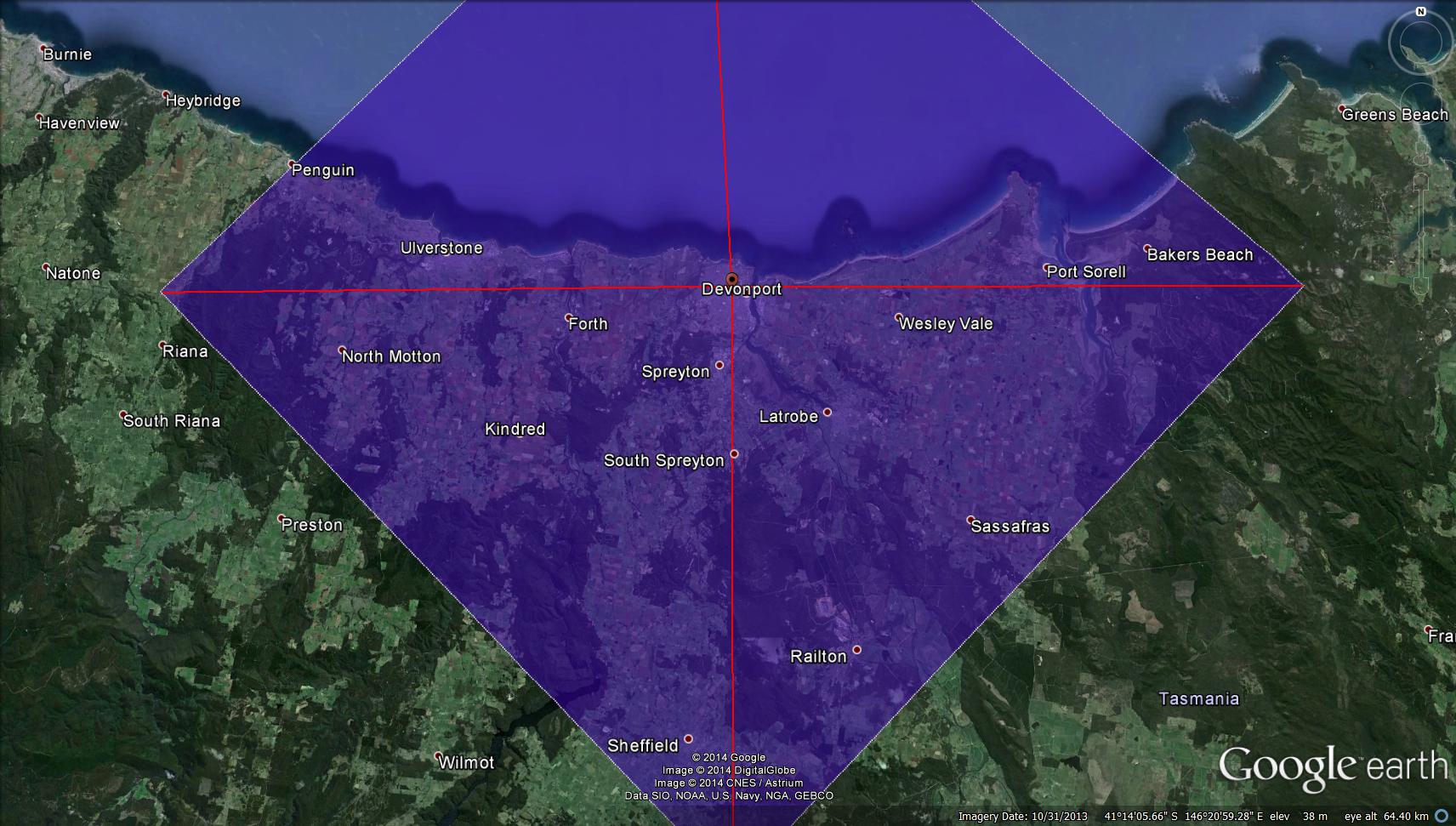 this is the area that our light would reach. It’s out to Penguin in the west, Down past Sheffield to the south, and out past Port Sorrell and even past Bakers Beach. The light of our love can shine out past just our little town of Devonport, but even as far as what’s shown here.
And finally, if we are to be a lighthouse, we must be a place of safety near danger. In Matthew 11, Jesus says, “the Son of Man came eating and drinking, and they say, ‘Look, a glutton and a drunkard, a friend of tax collectors and sinners!’ Yet wisdom is vindicated by her deeds.” Jesus was indeed a friend of sinners – he ate with Tax Collectors, he talked with prostitutes, he touched lepers. The people that society rejected found safety with Jesus. They found acceptance with Jesus. If we are to be a lighthouse, then we must also be a place where people can feel safe and accepted – whether they are accepted by society or not. If we are to live up to our vision, then we must live like Jesus – and not care or judge what people are, but love them all the same.
Do you wanna be a lighthouse?
But, we must also remember that the church isn’t just the building. Our corps isn’t located just at 166 William St. Bridget Willard said “Church isn’t where you meet. Church isn’t a building. Church is what you do. Church is who you are. Church is the human outworking of the person of Jesus Christ. Let’s not go to Church, let’s be the Church.” If we, as a collective church, are going to fulfil our vision, I hate to say it, but you can’t leave it up to me. I can’t do it all. If we’re going to fulfil this vision, then we must all live this. We must all be lighthouses in the communities that we live in.
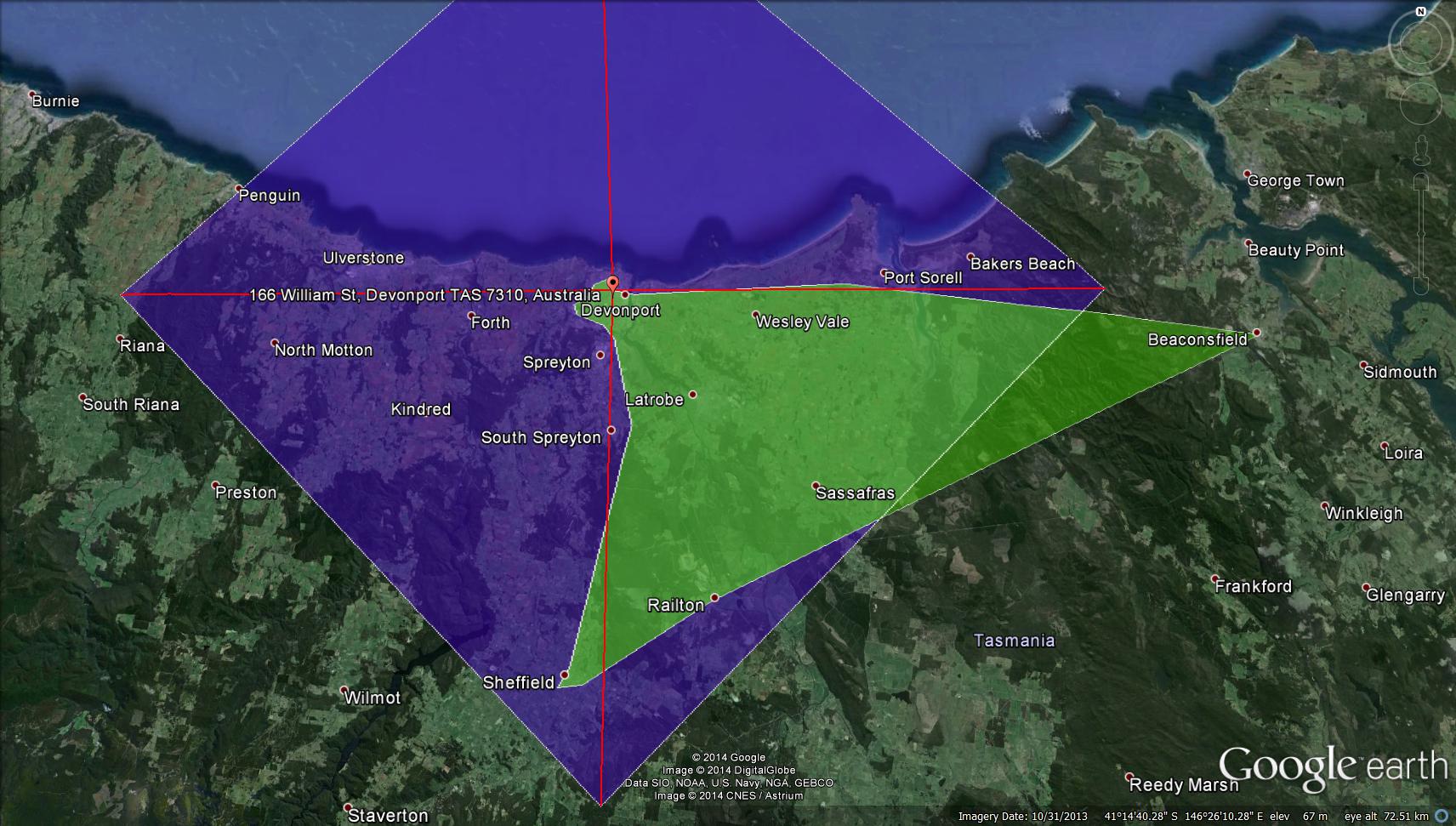 This image here is where we live as a corps. All of us live somewhere within that green polygon. If I extend that out 30km from out northern, eastern, southern and western most addresses, this is the area that we cover. That’s out past George town, Lower Turners Marsh and Bangor in the east, Mole Creek, Mayberry and Caveside in the south, and Riana in the West. If we can all be lighthouses in the places where we live, how much more effective as a corps will we be?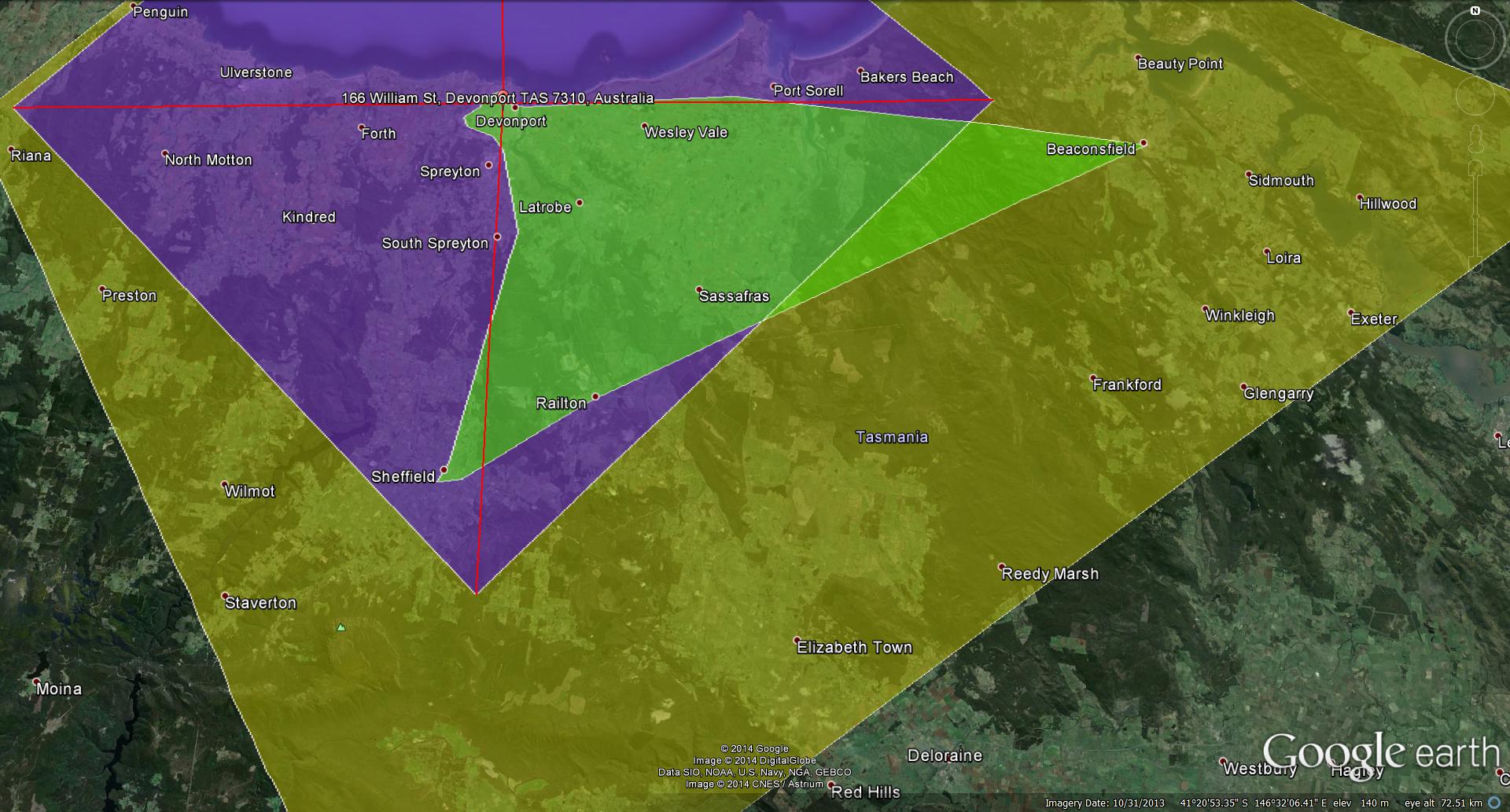
So, if you’re going to be a lighthouse, you must be a central point for people to look for. Now, I’m not talking about being so loud that everybody takes notice of you – though, if you are that naturally, then brilliant. What I’m talking about is living in such a way that people sit up and take notice, and ask the question, “Why is this person like that? What’s so different about them?”
If you’re going to be a lighthouse, you must show people the way. You need to be willing to share your story with people. If someone comes up to you and asks you, “Why are you like that?” You’ll be able to share with them how Jesus has changed your life, and that he can do the same for them too.
If you’re going to be a lighthouse, you must show evil for what it is. Stand up for those who are being bullied, stand up for those who have no voice. Don’t be afraid to speak out when you see something that’s wrong.
If you’re going to be a lighthouse, you must shine light into the darkness. The only way we’re going to reach as far as that last image showed is if we make love our default response. If we show love everywhere we go, then the love of God will extend from us and into our communities.
And finally, if you’re going to be a lighthouse, you must be a place of safety near danger. Be welcoming to all who you come into contact with, and show them that love that is shown to you by Jesus. Don’t judge, as judgement is left to God alone. Just love them, everyone that you come in contact with, whether they’re accepted by the community or not. Love them.
I truly believe that we, as a church, are called to be a lighthouse to our community, and that we do need to be a place for people to look to, that we need to show evil for what it is, show the way, which is Jesus, and shine light and love into their darkness, while being a place of safety near danger. But, as I said, we can’t do any of that unless we have many more lighthouses out in the community. Together, we can let others experience the life changing power and freedom found in Jesus.
A few months ago, I introduced a song at a kidzone meeting called “We are” – and the chorus says “We are the light of the world, we are the city on the hill.” The Second verse says “We are called to spread the news, Tell the world the simple truth, Jesus came to save, there’s freedom in His Name, So let it all break through.” If you believe that you’re called to spread the news, and to tell the world the simple truth, I would ask you to stand when we get to that verse, and commit to being a lighthouse in the community where you live.
Called to be Holy
As has been my tradition, every sermon that I preach will be posted here. This sermon, Called to be Holy, was given at The Salvation Army Devonport on Sunday 15 June, 2014. The Reading was Matthew 28:16-20.
Have you ever felt that you were too small to really make a difference? Thinking, “this town is too big for me to make a difference” or “how can I make a difference in this world that is so large” or “why would anyone listen to me?”
One of my best friends is absolutely incredible. She’s lived an incredible life – which is another talk in itself – and has been through all sorts of things in that time as well. In 2009, Daena committed to completing one random act of kindness each day, until her 25th birthday. She opened it up so that others could submit their acts of kindness as well, in the hope of getting 1000 acts of kindness by her birthday. Since then, she’s committed to completing a random act of kindness every day, and has done so – apart from a recent 3 month hiatus due to significant family issues – up until this date. On her blog, she says that she is “just an ordinary person looking to make a difference to the world, one small act of kindness at a time.”
I’m reminded of a story from the bible, where 5000 men, with women and children on top of that, were gathered, listening to Jesus teaching. With the crowd being hungry, Jesus poses the question to Philip, “Where are we to buy bread for these people to eat?” Philip answered saying that “Six months’ wages would not buy enough bread for each of them to get a little.” Then Andrew pipes up, “There’s a boy here who has five barley loaves, and two fish. But what are they among so many people?” Continue reading “Called to be Holy”
What does your welcome look like?
I was reminded by a friend’s Facebook post of an odd practice by some churches where they get newcomers to stand up, and the church welcomes them with applause. It got me thinking about the different ways we welcome newcomers – from welcome lounges to welcoming them by name, welcome packs to an invitation to the pastor’s house the following Sunday for lunch (and a guaranteed 2nd visit). Some of them can be pretty confrontational, particularly if the visitor isn’t certain whether they’ll return next week.
Yet, there is this sense of urgency in welcoming a new visitor to your church. We want to welcome them, the thought being that if they feel welcome then they will be more welcome to return again, and perhaps become a member. But if we come off too eager then we will scare them off with our welcoming. A tough line to tread.
This post has no answers, but I’d love to hear what your church does. At Devonport Salvation Army, we have a welcome pack which we offer visitors, which includes a book, some information about our programs, and some chocolates. I don’t know how well this works yet, but it’s what we have. I’d love to hear how your church welcomes new people, and as a challenge, why don’t you go to another church and see how they welcome you!
 Ben Clapton