As has been my tradition, every sermon that I preach will be posted here. This sermon, Worship as Lifestyle, was given at The Salvation Army Devonport on Sunday 11 October, 2015. The Reading was Amos 5:1-15.
There are 3600 seconds in an hour, 86,400 seconds in one day, 604,800 in a week and over 31 million seconds in a year.
To put that in perhaps more realistic terms, we know that there are 60 minutes in an hour, but that makes 1440 minutes in a day, 10,080 in a week, and 525,600 in a year.
All of us, no matter how good we think we are, only get the same number of minutes in a week. So how well do we use those minutes?
On Average – and these are all figures I sourced from the internet so they must be true – we will spend 168 minutes a day watching TV. That’s 1176 minutes during the week, or almost 12% of the week.
The average American spends 128 minutes on either their smart phone or computer. That’s 896 minutes a week, or almost 9% of your week.
You will spend, on average, 456 minutes sleeping each night, that’s over 30% of your week. We’re up over half of our week gone already!
You’ll spend only 66 minutes a day eating, that’s only 5% of your week.
If you’re employed, you will spend 516 minutes a day either working, thinking about work, getting ready for work and other work related activities. That’s 35% of your week. And by my quick maths, that leaves us with less than 10 percent left. How much have I left out?
When I was teaching violin, I would always stress the importance of daily practice to my students. I would get them only once a week. If they were lucky, and received an hour-long lesson, that would be only half a percent of their week. If they were to practice for an hour each day, their time spent learning violin would come to nearly 5% of their week. Continue reading “Worship as Lifestyle”→
It’s December 1st, 1955. A sensibly dressed woman in her forties gets on a bus in the early evening. Despite having spent all day bent over an ironing board in the basement tailor shop at Montgomery Fair department store, she carries her swollen feet and aching shoulders erectly. She sits in the first row of the Coloured section on the bus, and watches the bus fill with riders. Until, that is, the driver orders her to give her seat to a white passenger. Her response was just a single word, but that word was filled with so much meaning and started something that would only be realised later. She said, “No.”
The Story goes that Rosa Parks was tired of being pushed around and decided to sit down. For me, this is part of the story that resonates with me. After years of fighting for the rights of Asylum Seekers and Refugees in Australia, Christian leaders are tired. They have worked, and continue to work the political process. They have written letters, signed petitions, visited politicians on all sides of the spectrum, and still our nations treats those in the most need in ever increasingly worse ways. We are tired of fighting and getting nowhere.
Praying inside Senator Bushby’s office
So on Tuesday, I joined in with a movement of other tired Christian leaders, and with five others, we sat. We asked for a response, and got none. So we sat. We prayed. And we waited for a response.
Ben being led out by the police after being arrested
We sat, asking the Senator to release a statement saying that it was abhorrent that there were 127 children in immigration detention. We offered for him to be a hero to these children, insisting to the Prime Minister and Immigration minister to release them and their families immediately. But we received no response. So we sat, and we prayed, and having received no response, we were eventually arrested.
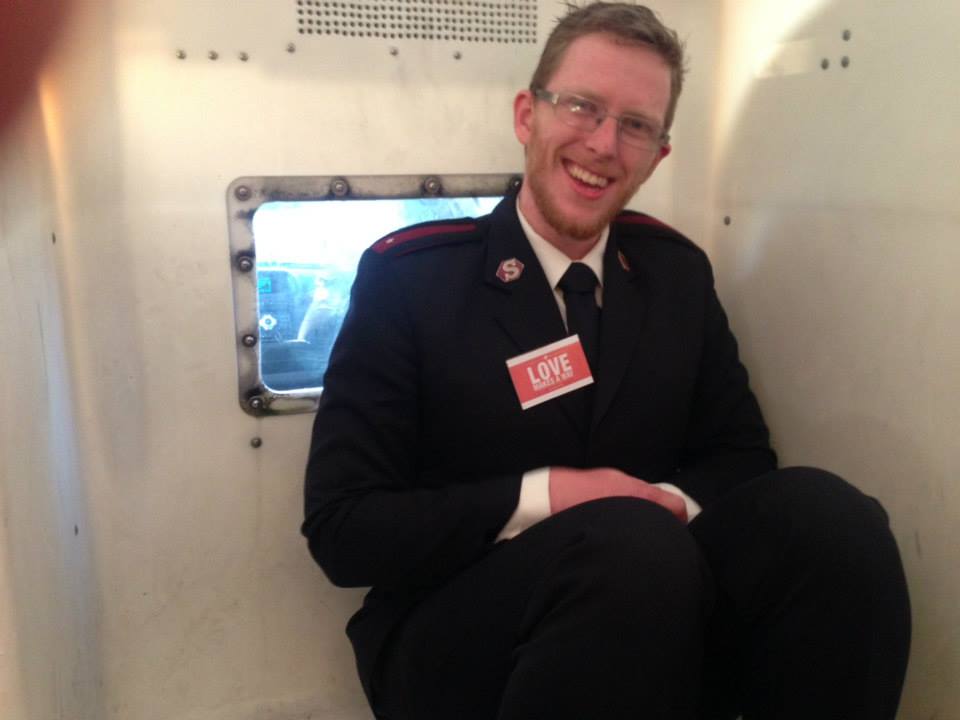
Ben in the Divvy van
So we sat in the Divvy van, knowing that while the police had treated us well, there were many in Manus Island and Nauru who have been treated harshly by security guards and police.
The Love Makes A Way group in the watch house
So we sat in the watch house, while the wonderful police officers promptly filled out the paperwork and processed us, knowing that there still has not been one asylum seeker claim that has been processed on Manus Island.
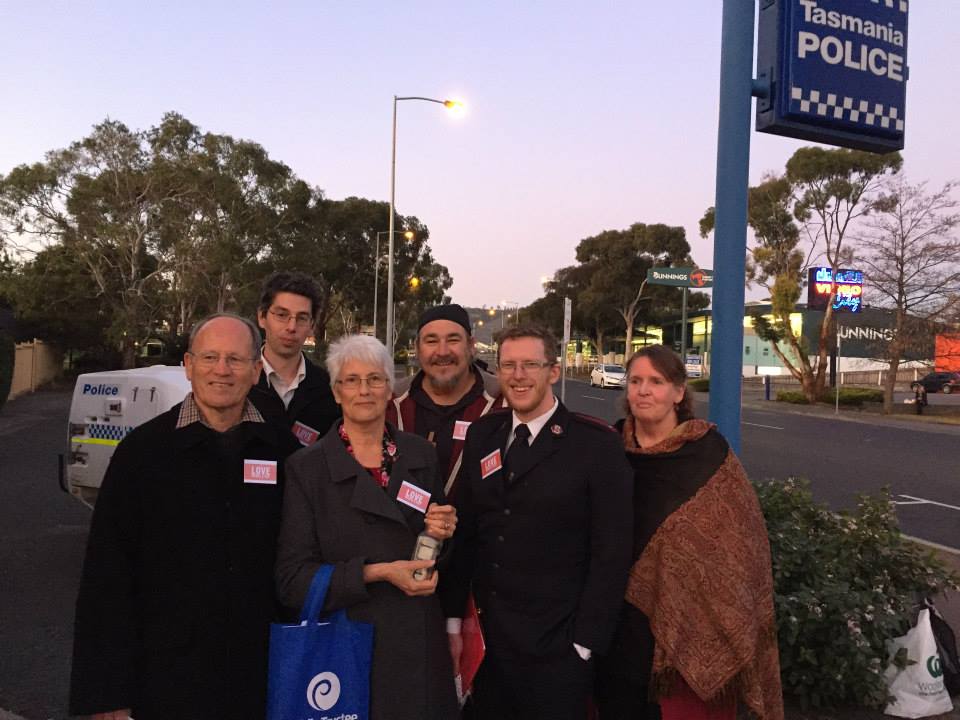
The Love Makes A Way crew, released on bail
And as we walked free from the Police Station, into the waiting arms of our support crew, we go knowing that there are still 127 children locked away in immigration detention. That there are still over 2000 people locked away in immigration detention, many who have been there for over two years. And that while the boats may have appeared to have stopped, that there are still millions of people seeking protection and asylum all over our world, seeking safety from oppression.
Aside – My Love Makes A Way Action
I feel, at this point, that I need to step aside and clarify a few things that may have been raised in your mind. Firstly, this action has been a long time coming. I have been preparing myself for this action for over a year, and planning for this action started in April. I also sought, and received, approval and support to take part in this from both the Territorial Commander and the Divisional Commander. So I didn’t act on this alone, but with the approval and support of leadership. You may wonder why I hadn’t mentioned that I was intending to take this action. Part of it is that it is kept confidential, so as not to alert the senator and his office prior to the action. Another part is that it helps gain discussion throughout the community and social media, with people surprised that it is happening. This is a vital part to continue the discussion, as we aim to not only change the policy, but also to change the discussion within the community and within the church. And while we weren’t able to change the policy in this action, we are still able to change the discussion in the community and in the church. So feel free to come up and chat with me about anything relating to Asylum Seekers if you have any questions.
There are people in this world who are oppressed
The reality is that in our world today, there are many people who are oppressed. They are oppressed by people who have power. They have their rights taken away from them by people who have power. They could be asylum seekers seeking safety from war-torn countries. They could be the disabled, facing uncertainty about the level of support by a government intent on reducing our welfare bill. They could be Aboriginals, being pushed out of their traditional lands. That’s just a few situations that are happening right here in Australia, but there are thousands more all around the world. And quite often, people in those situations will think that they have no hope. How can they possibly change the world – they are, after all, just one person.
But that’s exactly what Jesus was teaching right here in this passage. Jesus was giving those people who were oppressed the opportunity to be seen as an equal. To give them some power back. How? Let me show you.
First, I need a volunteer. Now, back in Jesus’ day, there were very strict rules as to what you would do with your hands. One of the things is that you would only ever slap someone with your right hand. So, please put your left hand behind your back. Now, there are two ways to slap someone. Open handed, or back-handed. Now, Open handed slaps, they were for men of equal standing. Think of those days of old, or possibly in the movies, where someone would challenge another to a duel by slapping them. But a back-handed slap, that was for someone who was lower than you – a master slapping his slave for example.
So if you were only to use your right hand while slapping, and you were going to slap me on the right cheek, would you have to do it open-handed or back-handed? And this would be known by the crowd – if someone slapped you on the right cheek, it was because someone saw you as less than them. However, if you then turned the other cheek, forcing them to hit you on the left cheek – there was only two options for them. To slap you again, this time with an open hand, signifying you as equal, or to walk away, surrendering their position. In this way, Jesus was able to put power back into the hands of the powerless.
In the same way, if someone was suing you to take your coat – it was only because you had nothing else left to give. For someone to sue you for your coat means that they are so insistent on damaging you that they will take everything that you have. The cloak – that was effectively their last layer of clothing, it was the only thing giving them any dignity. So when Jesus says, give them your cloak, he was effectively saying for them to disrobe, to get naked. Why? Because it gave the powerless a voice. It was allowing the person being sued an opportunity to say to the oppressor, “look at what you are doing to me. You have reduced me to this – that I have no dignity left.” And by doing that, it forces the oppressor to think about what he is doing – to be the person that left someone naked (and lose standing in the community), or to give up his claim on the other person. Again, Jesus was putting power back into the hands of the powerless.
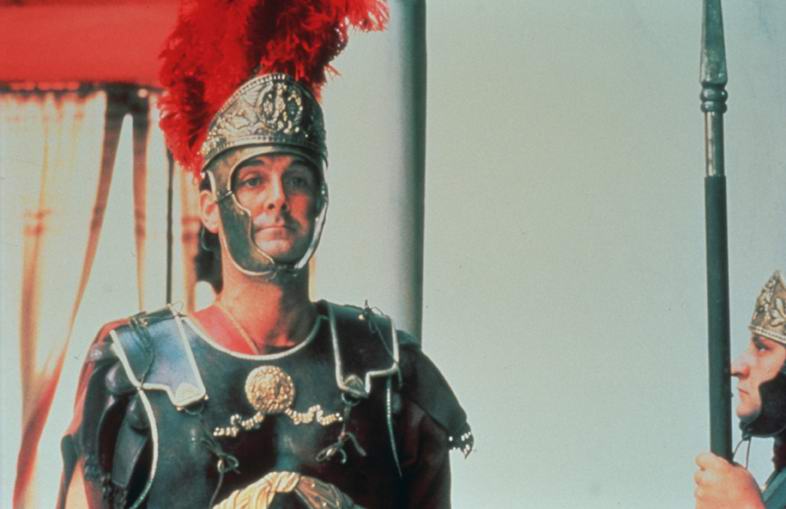
This is an accurate photo of a Roman centurion, right?
The final example Jesus gives is going the second mile. Now, we know that the Romans were occupying Israel at the time, and a Centurion was able to conscript a Jewish person to carry their pack for them, but only for the distance of one mile, no more. If it was carried further, then the Centurion was able to get in quite serious trouble. So if a Jew was to get to that one mile mark, and to just keep on walking, the Centurion would be running behind them, pleading with them to put the pack down. And with that, the power has once again gone from the powerful to the powerless.
Jesus gives us dignity through our choices
This is what Jesus was hoping to achieve through this. He wanted to give power to the powerless. To give them a dignity in life. And he offers that same dignity to us as well. It’s unlikely that you will be slapped in today’s age, and our understanding of position and customs are different from what they were back then. Taking off your cloak will not have the same effect that it did in Jesus’ day. And there aren’t any Roman Centurions around to force us to carry their packs. But through what Jesus is saying here, we can take his message and apply it to our own lives. In every situation, we have a choice on how we act. We can choose to act and show love to all people. We can choose to treat all people as equals. And we can choose to stand up and be a voice for those whose voices are oppressed by people in power. In Proverbs 31:8-9 it reads “Speak out for those who cannot speak, for the rights of all the destitute. Speak out, judge righteously, defend the rights of the poor and needy.” This is what God is all about – because we are all God’s creation, and we are all created equally in God’s image.
We can see all people equally, and love all people equally
When we start to see all people equally, we start to see them how God created them. When we start to see them how God created them, we start to understand that they deserve to be treated with the same love and respect that God shows us. The same love and respect that gave us dignity in our choices. The same love and respect that doesn’t force us to worship him, but invites us to come and worship him as we see fit. The same love and respect that sent his son to die for our sins, so that we could enter into a full relationship with him.
Go, love your neighbour, and all others
That same love that God shows us, he calls us to love each other. Because if God shows it to us, and we are all created equal, then we should show it to all others as well. So we need to Go out from our building here, and show love to all people that we meet. We need to give love and dignity to all people that we come in contact with, because that’s what God gives us. And whether we are the powerful or we are the powerless, we need to treat all people as equals.
What’s God telling you today? Maybe he’s asking you to speak out for those who have no voice. Maybe he’s showing you people who you need to treat with love and respect. Maybe he’s showing you a way to stand up and be treated with love and respect.
In our response time today, you’re welcome to come and pray about whatever it is that GOd has told you today. Maybe you just want to come and pray for the 127 children who are still in detention. Or maybe you want to come and pray for the children in our community who go to school without breakfast or lunch. To pray for those around the world suffering in war zones, or to pray for God’s creation, and the way it has been ravaged by humanity’s greed.
As we do that, you are invited to join in this song that says “God of the Poor, friend of the weak, give us compassion we pray. Melt our cold hearts, let tears fall like rain. Come, change our love from a spark to a flame.”
I want you to think back to your high school days. That might be easier for some, or harder. It might bring back pleasant memories, or painful ones. But we all know that in high school, there was generally two groups. There may have been lots of different groups, but in general, they broke down to two main groups – the In crowd, and the out crowd. Which one were you in?
I know that for me, I was most certainly in the out crowd. I wasn’t one of the popular kids. I didn’t fit in. And try as I might to try to get in with the popular crowd, I most certainly never did. I didn’t have the right look, the right speech, the right hair, the right interests, whatever it was that I needed to be part of that crowd, I didn’t have it.
Now, you might see similarities in our society today. There are the in crowd and the out crowd. Those favoured by society, and those despised by society. Those who have it and those who don’t – whatever it is. I’m reminded of a scene from the Simpsons, where Abe Simpsons says “I used to be with it, but then they changed what *it* was. Now what I’m with isn’t *it*, and what’s *it* seems weird and scary to me. It’ll happen to you…” Whatever is it now, will eventually be not it later. Keeping up with it is difficult, unfulfilling and eventually not worth your time. Continue reading “The Christ Crowd”→
Has anyone here ever sculpted anything? Started off with a block of something and made it into something else? You may have heard of the quote falsely attributed to Michelangelo, who apparently said about his statue of David, that he started with a block of marble, and just chipped away anything that didn’t look like David. It’s that simple! You just chip away anything that doesn’t look the way that you wanted it to look.
You may remember a while ago, Liesl got me to bring in something that I had made – Here’s the finished product. This part here, it was once a square piece of huon pine. Then I decided what I wanted to make, and I just removed anything that didn’t look like what I wanted. With that in mind, I want you to watch this video. Continue reading “Holiness drives us out to Mission”→
Zahra and Ali* were Iranian Christians, persecuted because of their faith, and had fled with their family to seek safety. After having spent some time on Christmas Island, they were moved to Manus Island, and it was here that I met them on one of my first shifts. They were sitting underneath a shelter, and in an attempt to escape the heat, I wandered over and said hello. They introduced themselves, and offered me a cup of tea. Despite the circumstances that they found themselves in, they knew the importance of being hospitable, and welcoming this stranger into what was effectively – for the time being – their home.
Over my time there, Zahra and Ali were the family that I connected with the most. Every shift, I would seek them out, to see how they were doing, and even just to sit with him and chat for a while. I still think of them often, and while I don’t know whether they are still in detention, or whether they have received visas, I pray that one day our paths may cross again. Continue reading “Refugee Sunday”→
Have you ever competed in a race?
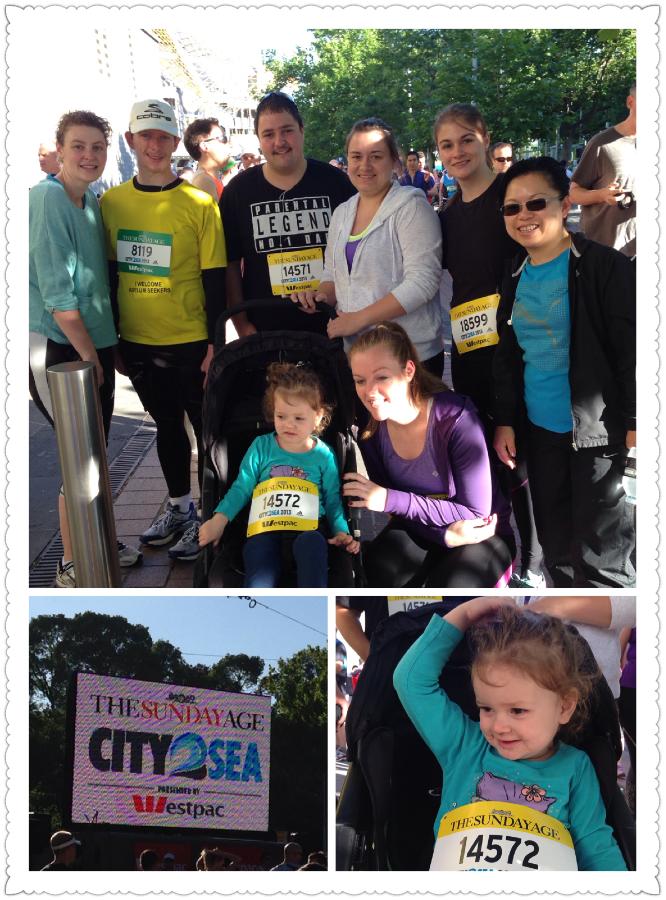
I have, and I can tell you, it’s hard work. I first competed in the Melbourne City2Sea, a 14km fun run, back in 2012. I had taken up running that year, and it was my first real challenge – having never run anything over 10km before. In the lead up to the race, I followed a plan that slowly increased the distance that I was running, so that I was able to complete the race.
Ben and his session mates doing the 2013 City2Sea
The following year, I did it again, following a training plan and getting myself ready for the big day. Then last year, I convinced myself to get out in the rain and run it one more time, this time 15km.
Each year, in order to reach my goal, I needed to prepare. You can’t just wake up on a Sunday morning and go, “I’m going to run from the MCG to St Kilda today. No, you need to put in some preparations beforehand. You need to put in the hard yards, run the kilometers, and get your body ready for the race. Continue reading “Preparing for the Work”→
I believe we all know that I am a bit of a geek… and a geek who loves Star Trek. So I hope you’ll forgive me when I say I’d like to show you a clip from Star Trek. Let me set the scene. Khan has set off the Genesis machine, after a battle with the Enterprise. The Enterprise is damaged, and can’t jump to warp speed to escape. Spock hears this, and heads into the radiation filled warp chamber, and fixes the warp drive, knowing that it will kill him. They escape, then Kirk is called down to the engine room.
“I have been, and always will be, your friend.” It’s possibly one of the most famous of Star Trek quotes. And it got me thinking – that quote kinda sums up how God feels towards us. He has been, and always will be, our friend. And as I was reading this passage, that’s really what I could see – that no matter what, God has been, is, and always will be our friend.
The thing is that we often don’t recognise that. We say that we can’t possibly have God’s love after the things that we’ve done. There are things that I’ve done in my life that I’m deeply ashamed of – surely God can’t love me knowing that I did that.
The passage we heard of today tells of the prophet Jonah taking God’s message to the city of Nineveh. That message was “Forty days more, and Nineveh shall be overthrown!” But what do we know about Nineveh?
Well, we actually know a fair bit. Nineveh was founded by Nimrod, the first on earth to become a mighty warrior. It was condemned by Zephaniah for its arrogance and forcast for destruction. Zephaniah 2:13-15 tells us that Nineveh will be made into “a desolation, a dry waste like the desert,” where “Everyone who passes by it hisses and shakes the fist.” In the book of Nahum, which is all about the destruction of Nineveh, we read Nahum describe the city as the “city of bloodshed, utterly deceitful, full of booty – no end to the plunder!” By all accounts, Nineveh was evil incarnate, and deserved to be destroyed.
And from what we read as well, we can see that people weren’t willing to show God’s love to Nineveh, either. You can see Zephaniah prophesied against it, and Nahum is a whole book celebrating its destruction. When Jonah is told to go and bring a message to Nineveh, he runs away, he doesn’t want to go there. And we read his reason why in chapter 4, “Is not this what I said while I was still in my own country? That is why I fled to Tarshish at the beginning; for I knew that you are a gracious God and merciful, slow to anger and abounding in steadfast love, and ready to relent from punishing.” Jonah didn’t want to go tell Nineveh about God’s message because he knew God wouldn’t destroy them.
You look at that and you can see that we do both things. We put ourselves in boxes, and say that we don’t have the right to deserve God’s love. The things we’ve done are so bad that God couldn’t possibly love us.
But we also do the same thing as Jonah. That person over there, you don’t want him God. Don’t you know what he’s done? He’s a liar, a cheat, he does this, he is that. Surely, you don’t want Him God.
Yet let’s look at how Nineveh, that city of bloodshed, that despised, hated city, who is evil incarnate, is described in the book of Jonah.
1:2 “Go at once to Nineveh, that great city”
3:2 “Get up, go to Nineveh, that great city”
4:11 “And should I not be concerned about Nineveh, that great city”
And you know what – each description there? That’s God speaking to Jonah. God describes Nineveh as a great city. And despite of everything you’ve done, God describes you as a great person.
We can repent and turn back to God
But just because we can be assured that no matter what we do, God loves us, doesn’t mean that we can do anything we want. God still sent a message to Nineveh and that message had a threat of destruction in it. God gave them 40 days, and if nothing happened then Nineveh would be overthrown. So what does Nineveh do? Firstly, the people believed God. The message is shown to us and the first thing we must do is believe.
Secondly, they acted. They proclaimed a fast and everyone put on sackcloth – an act of repentance. When news reaches the King, even himself covered himself in sackcloth and ashes, and says “All shall turn from their evil ways and from the violence that is in their hands. Who knows? God may relent and change his mind; he may turn from his fierce anger, so that we do not perish.”
While we may have done bad things in the past, we are always able to stop, to repent, turn around and go in the direction that God is calling us.
We can live in the love of God
And what is that direction? We read in a few different places what God requires of us. In Micah – the book after Jonah – we read “He has told you, O mortal, what is good: and what does the LORD require of you but to do justice, and to love kindness, and to walk humbly with your God?” In Matthew, we read Jesus tell a Lawyer what the greatest commandments are: “You shall love the Lord your God with all your heart, and with all your soul, and with all your mind.” This is the greatest and first commandment. And a second is like it: ‘You shall love your neighbour as yourself.’”
That’s really what it all boils down to. When we repent, and accept God’s forgiveness, we then start living as Christ calls us to live. To love God humbly, with everything that we have. To love others, showing kindness to them and ensuring that we have justice for all. And to love ourselves – because how can we love others if we do not love ourselves?
Accept God’s love in your life, and offer it to others
So today, I invite you to accept the fact that God loves you. There’s nothing you can do to change that. Nothing you can do will change the fact that God loves you, and loves you so much that he sent his son to die for your sins. Just as Spock sacrificed himself, so that the rest of the ship could live, so Christ sacrificed himself so that all who believe in him will live. It’s Christ, there on the cross, saying “I have been, and always will be your friend.” So how will you respond to God’s love? Will you repent of your sins, and turn to follow Christ and how he’s calling you to live – loving God, loving others, and loving yourself? Will you offer that love to others, knowing that God’s love is available for all?
I invite you to come and respond to God’s love here today. While we do that, we have this song that says “Lord, I come, I confess” – we need to confess to God of our sins. “Without you I fall apart” – we can’t do anything unless we have Christ with us. “You’re the one that guides my heart” – when we’ve confessed, Christ guides our heart into right action.
While we sing, you’re invited to come and confess to God, to come and repent of your sins. Maybe you’re holding onto something that’s stopping you from fully accepting God’s love. Maybe things you’ve said have stopped others from coming to accept God’s love. Maybe you just want to come forward and pray. Someone will come pray with you, or you can bring someone with you if you prefer. But this is your time, to accept the love of God that’s always been there, and turn around and follow Christ.
In the beginning… In the beginning, God… In the beginning, God created… it’s such an Iconic opening sentence, and it holds so much power and understanding for us. And depending on how you want to break it up the first few words can put a whole difference spin on the creation story. In the Beginning, tells us that this story starts at the very beginning – there is nothing more before this. In the Beginning, God, tells us that from that very beginning, there was God. And In the Beginning, God created, tells us about this God – that God is a creative God, one who isn’t content to be there alone, but wants others as well.
Peter Parker gets bitten by a radioactive spiderI watched an interesting video the other day that talked about creation stories of various superheros, and how they reflect who we are, and what we are fearful of, and what we aspire to. For example, he highlighted how in the early mythology of Spiderman, he got his powers from what? Continue reading “Creation Stories”→
As has been my tradition, every sermon that I preach will be posted here. This sermon, The Prince of Peace, was given at The Salvation Army Devonport on Sunday 21 December, 2014, for our Christmas with the Salvos Carols service. The Reading was Isaiah 9:2-7.
I chose the passage for today a few weeks ago. The theme for this Sunday was chosen a few weeks earlier than that. And as I sat down on Tuesday morning, in a coffee shop just down the road, only 24 hours after a siege in another coffee shop in Sydney had started, which ended up costing three people their lives, and changed the lives of countless more, I had to wonder how I could possibly preach on peace, when our peaceful existence has been so shockingly changed.
We live in a world characterised by it’s non-peacefulness
The unfortunate reality is that we live in a world that is characterised by it’s non-peacefulness. Wikipedia currently lists 13 Wars and conflicts currently happening around the world. So far, in 2014, that has resulted in at least 113,804 deaths. Over 100,000 deaths in this year alone. That is almost as many as the average number of deaths per year during the Vietnam War. If you add in those classed as minor skirmishes and conflicts, you have 44 Wars, Conflicts and skirmishes, with pushes it up over 118 thousand deaths in this year alone. Some of this conflicts have been going on since 1948 – the cumulative fatalities caused by these active skirmishes tops 6.5 million. The United Nations High Commission for Refugees reported that in 2013, we had 51.2 million forcibly discplaced people. This is the highest on record. During 2013, conflict and persecution forced an average of 32,200 individuals per day to leave their homes and seek protection elsewhere – up from 23,400 in 2012 and 14,200 in 2011.
But it’s not just armed conflicts that we have to worry about. Life seems to get busier and busier. That business leads to stress, which means that we can’t perform at our best, and can lead to mental and physical health problems. Elsewhere in our society, people are dealing with poverty, drugs, violence, domestic violence and more. All of these things chip away at that ideal, peacefilled existence. Continue reading “Prince of Peace”→
As has been my tradition, every sermon that I preach will be posted here. This sermon, Don’t get stuck in the room, was given at The Salvation Army Devonport on Sunday 23 November, 2014, in our first Sunday back in our building following renovations. The Reading was John 20:19-23.
Who knows what next Sunday is, in the Church’s calendar? That’s right, the first Sunday of Advent. Hands up, who puts their Christmas Decorations up on the first Sunday in Advent? And who puts them up on December 1? And who’s got them up already?
Here’s a trickier question – who knows what today is, in the Church Calendar? Today, in the Church Calendar, is what’s known as Christ the King Sunday. And it’s this day that confused me for a long time with the set readings for the day.
If you don’t know, many churches use what’s called a lectionary, which is usually a three year cycle of readings that they will use for their services. There’s a few different ones around, but for the most part – particularly for the high feast days, they will have the same, or similar readings. And this day is one of them, where they will usually have a story related to the crucifixion.
Now, I never really got that until recently. It seemed to make no chronological sense – we were right about to get into Advent, the period of time where we prepare for Christmas, and all of a sudden, we’re brought back to Easter.
I didn’t get it for a long time, until a realised that – through the lectionary – we were being reminded that the whole purpose of Christ’s birth, the whole reason we have Christmas, was so that he would eventually die on that cross, and rise again, and be able to invite us all into eternal life. Continue reading “Don’t get stuck in the room”→








 Ben Clapton