It’s NAIDOC week in Australia, where we celebrate Aboriginal and Torres Strait Islander culture as a vital and important part of Australian culture. There is a strong culture of music in Aboriginal culture – in their beliefs they talk about songlines – the paths across the sky and sometimes the land that mark the route followed by creator-beings during the Dreaming. As such, it is unsurprising that there is a group of musicians who are breaching the gap between traditional Aboriginal music and Western Art Music, and using this new medium to share their stories and culture.
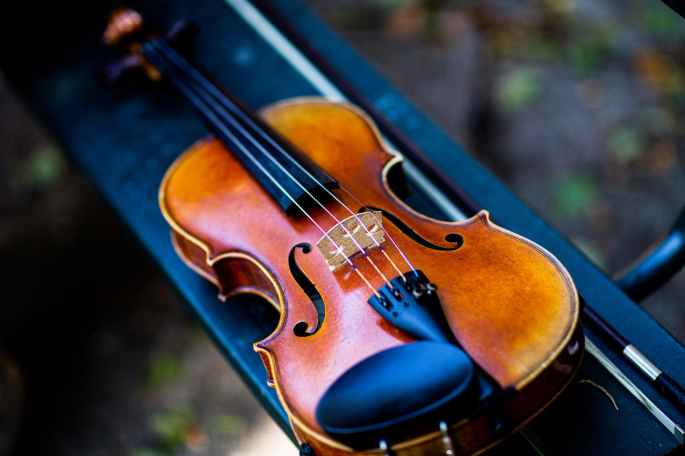
Eric Avery is a Ngiyampaa, Yuin, Bandjalang and Gumbangirr artist. Formally trained in Dance (NAISDA Dance college and a mentorship at The Australian Ballet) and Music (Bachelor of Music from the Australian Institute of Music), he combines his skills on the violin to perform classical music and create new contemporary music that expresses his Koori (NSW Aboriginal) heritage. He works with his family’s custodial songs, reviving them and continuing the age old legacy of singing in his tribe.
Galinga (water song) is an incredibly emotive piece that incorporates Avery’s native tongue with traditional violin playing and looping textures to create a rich tapestry that evokes a babbling brook.
In Wirrangintungiyil, Avery performs with his father on Didgeridoo, utilising a healing lullaby that he learned from recordings of the King Family. Avery talks about how utilising native languages has been transformative and healing for him in reclaiming his culture.
ABC Classic FM has a fantastic page highlighting a number of stories and performances around Indigenous performers and composers that is well worth checking out.
Following up from yesterday’s post about the top five historical violinists, today we have the top five modern violinists. These are the violinists that if they come to do a concert in your town, you should do everything you can to get to see them. These are the ones that you should be watching and listening to for the best quality recordings of today. And these are the ones that I just prefer to listen to. Let’s get into it.
There are many brilliant violinists around today, and tomorrow I will share with you my five favourite modern day violinists. But all of these violinists are built on the shoulders of the greats who came before them. While in my opinion the Romantic period of classical music (1830-1900) is the period that produced the greatest violin works, it is in the 20th Century that the best violin performances dominated. These giants still influence modern thought and stylistic interpretation, and today I want to share with you my favourites. And thanks to the wonderful world that is YouTube, we have live recordings and performances of all of them.
In the spring of 1825, Ignaz Schuppanzigh, an Austrian violinist, was engaged to perform the premiere of Beethoven’s latest quartet, written some 15 years after his last quartet which premiered in 1810. Schuppanzigh, with his quartet consisting of Karl Holz on second violin, Franz Weiss on viola and Nikolaus Kraft on cello, gave the first performance of this piece on 6 November 1825, and whilst reports said Beethoven was not pleased with the performance and blamed Schuppanzigh, the quartet would go on to perform the two other quartets that were commissioned by the Russian Count Nikolay Galitzin.
You might think that a violin case is relatively simple – it’s got a violin, and a bow, and not much else. However, in the case of a violinist are multiple things that help you get set up, and be prepared for any contingency. Here’s a list of what I have in my case.
A number of years ago, I was planning the trip of a lifetime. I was going to fly to England, find a backpackers or something near Paddington, and go to as many Proms concerts as I could. The Proms are something so uniquely Brittish, but even more so is the traditional Last Night of the Proms.
I love being musical. I love playing on my violin. I love playing on the guitar. I also love singing. Having been a part of churches my whole life, there is something wonderful when people get together and sing.
So your child is starting to learn the violin, and you need to get a violin. You look at the music shop prices, and balk – surely it doesn’t cost that much for a violin! So you look on Gumtree, or Craigslist. Ahh, much better. How can there be such a big difference – does it really matter?
There’s lots of different things that go into a beginner violin, and when you buy from Gumtree or Craigslist, there’s no guarantee that you’re getting all of them, and no guarantee that you’re getting a violin that is in playable condition. So let me, an experienced violinist and music teacher, run you through the various parts, and why you shouldn’t buy a second hand violin from an unknown source.
Violin show pieces are the pieces which are at the limit of violin technique. They are difficult, flashy, and impressive. Here’s my list of the top 10 violin showpieces.
Paganini – Caprice 24
Paganini’s 24 Caprices are some of the most difficult for the violin, and being able to play any of them is a great accomplishment. However, the 24th Caprice is by far the most famous, and most difficult. Based upon a Theme and Variations model, this caprice employs many of the most difficult violin techniques in a musically solid base. This video is of Hillary Hahn performing this Caprice. Continue reading “Top 5 Violin Showpieces”→
As has been my tradition, every sermon that I preach will be posted here. This sermon, Cross focused or resurrection focused, was given at The Salvation Army Rochester on Easter Sunday April 21, 2019. The Reading was Luke 24:1-12.
Right place, wrong time
I’m sure you’ve heard of the phrase, Right place, wrong time. It’s this whole idea that you might be where you are supposed to be, but you’re either too early or too late to make the most of you being there. Or maybe, you’ve been in the wrong place at the right time – for example, maybe you late for something that you were meant to be at, but by being late, and being in the wrong place, it allowed you to make the most of an opportunity, to have a chat with someone that really needed to have a chat. The reality is that neither of these things are bad… it’s just not ideal. You just don’t want to be in the wrong place at the wrong time.
In our Bible reading today, we have something similar
told to the ladies who come to visit the tomb. They are told that they are
looking for the right thing, in the wrong place. Well, not exactly. They came
to the tomb looking for the right thing in the right place – that is, they came
looking for the dead body of Jesus, which would be expected to be in the tomb,
right where it had been left. Because, really, apart from Lazarus, there hadn’t
been many examples of dead bodies just getting up and moving.
Jewish tradition valued care of the deceased, and so
it was right for the ladies to come and anoint the body with spices and
incense.
And so, it seems really odd to hear the angel tell
them that they are in the wrong place. They were looking for the dead among the
dead. They were in the right place at the right time for what they were
intending to do.
Cross Focused living
I think many Christians are in the same spot as the
women were. They’re doing what they think is the right thing to do, and doing
it at the appropriate time if it was the right thing to do. They’re just
missing an important piece of information. They are cross focused.
What I mean by that is that many Christians put their
focus on what Christ did on the cross as the most important thing. That Christ
dying on the cross is the most powerful and significant thing that Christ did.
But Crucifixion isn’t unique to Christ. Jewish
historians Josephus and Appian both refer to the crucifixion of thousands of
people by the Romans. Crucifixion isn’t what makes Christ special. Many
thousands of people were crucified and stayed dead.
When we, as Christians, become too cross focused, and
live out our life and faith in a way that is cross focused, then the way we
interact with others becomes cross focused as well. That is, we become focused
on the punishment.
We live out our lives in a way that says “we don’t do
this” or “We don’t do that”. Even in Salvation Army Soldiership, we sometimes
get too cross focused, as when someone asks what soldiership involves, we’ll
say “we don’t drink, smoke, or gamble.” Surely, there is more to Christianity than
what we don’t do.
When we become too cross focused, our evangelism
methods become less effective. Cross focused evangelism tells people that if
they don’t change their ways, they will be punished. It seeks to convert based
on fear. And the only way for cross focused conversions to continue is to keep
establishing that fear. If you back slide, you will be punished. If you do the
things that we say are bad, then we will be very disappointed in you – we might
even throw you out of our club and not let you back in.
Stop looking for the living among the dead
But the angel tells the women to stop looking for the
living among the dead. Because Jesus isn’t dead. He’s not among the dead, he
has risen.
You’ll notice that in our church, we don’t use a
crucifix – that is, our cross doesn’t have a body attached to it. This
signifies that Jesus is no longer attached to the cross – he is living, he is
risen.
And as such, we need to stop looking for the living
among the dead – that is, we need to stop looking to bring people to faith with
cross focused thinking. Fear isn’t going to bring people into faith. And as
hard as it can be for the church to realise that, it is what we need to do.
Throughout history, the Church has held a position of
power within the community, and was able to utilise that fear to bring people
to faith, and keep them there. But these days, the church does not hold that
same position. As such, perhaps we need to look to Jesus’ response to sin, and
see how we might respond.
In Mark 2, Jesus heals a paralyzed man, having first
said to him “Son, your sins are forgiven.” He doesn’t write out a big list of
them, doesn’t ask him to repent, doesn’t say “Unless you follow me, I will not
forgive your sins”. He just forgives them.
Similarly, in Luke 7, where a pharisee objects to a
woman he declares as a sinner anointing Jesus’ feet with tears and perfume,
Jesus tells the pharisee a story, and then says to the woman, “Your sins are
forgiven.” She didn’t ask for forgiveness. Jesus didn’t lecture her and scare
her into repentance. He just forgave her.
Often, Jesus would forgive their sins and then tell
them to go and sin no more. He wouldn’t say what those sins were, and he didn’t
go into the details of consequences for not leaving their life of sin. There
was no fear, just an instruction to not sin any more.
Resurrection focused living
You see, while Jesus was very well aware of where his
life was headed, he didn’t engage in cross focused living. He didn’t scare
people into repentance so that he wouldn’t need to die on the cross, because he
realised that the cross was not the end game – it was just the necessary step
on the path to the resurrection so that we can live resurrection focused lives.
Jesus didn’t tell people what not to do. He didn’t
teach through fire and brimstone sermons. In fact, his harshest sermons and
criticisms were reserved for the pharisees who were so focused on cross
centered living. Most of his teaching was not telling people what not to do,
but instead showing them how to live.
Jesus shows his disciples that the way to live is to
show love, forgiveness, and mercy to all people. To show that life is better
with Christ than without.
Because I absolutely believe that life is better with
Christ than without it. And if you’re here today and you haven’t invited Christ
into your life, then I want to invite you to believe in Christ – not because
you’re going to go to hell if you don’t, not because there’s some sort of
punishment. No, I want to invite you to believe in Christ because I believe in
Christ, and I know that my life is better with Christ in my life, and I know
that your life will be better with Christ in your life.
Now, some may say to me, But Ben, what about all those
lists of sins that Paul lists in his letters, and I want to say to you that for
the most part it’s just good advice anyway – but unless you base that living in
the love, forgiveness, and mercy that Jesus teaches, then you’re still focused
on the Cross – you’re looking for the living among the dead. Jesus is alive,
and wants to share that life with you.
Resurrection power
So go out and live a resurrection focused life. Go and live a life filled with Love, forgiveness and mercy. Go and live a life that is filled with resurrection power living on the inside. Because life is better when you are filled with resurrection power, living a resurrection focused life, and sharing Christ’s resurrected love, forgiveness and mercy with all people.






 Ben Clapton