The Giant’s midget crowd

List of Australian rules football clubs in Aus...
The GWS Giants’ Jumper (Photo credit: Wikipedia)

On Saturday 26 May, the Greater Western Sydney Giants played their first match at their home ground, Skoda Stadium. A small boutique stadium, it’s capacity is 25,000. Estimates for the first game crowd ranged from 15,000 to 18,000. Instead, the first match was witnessed by a midget 11,887 people. The poor attendance drew criticism as to whether the expansion to Western Sydney was the right move for the AFL. I however say that only time will tell, as history will show us.

One of the first expansion clubs, the West Coast Eagles, on its first home game, attracted a crowd of 23,897 at Subiaco Oval, a ground that holds 43,000. This is from a state where football was strong and established – the stadium record attendance for Subiaco Oval is from 1979 when 52,781 people watched the WAFL grand final. Capacity wise, the Brisbane Bears did better with 17,795 fans witnessing their first match at Carrara Oval, which held 22,000, however their average attendance for the season was 8,965. The Eagle’s average attendance for home games in their first season was 24,434.

From 1987 to 2011, the West Coast Eagles, in an AFL friendly state, averaged growth of just over 2%/year in Home game attendance average. Brisbane, in a non-AFL friendly state, averaged growth of over 6%/year. Likewise, Fremantle has experienced almost 3% growth in average home game attendance since 1995, Sydney, over 3% growth in a non-AFL friendly state. In fact, the only two non-Victorian clubs to experience negative growth since entry into the AFL are the two South Australian sides, Adelaide Crows and Port Adelaide Power. It should be noted that South Australia and Western Australia are considered AFL-friendly states, while New South Wales and Queensland are considered non-Friendly due to the dominance of Rugby League. Yet, the average growth in these states exceeds that of the AFL friendly states.

In contrast, home game attendances since 1987 for Victorian clubs have all risen, by an average across the clubs of 4.5%.

As you can see, where attendance has been low in a club’s first match, it is not cause for alarm. Almost every club in the league has experienced growth since 1987, and the clubs in the non-AFL Friendly states have done better than those in the AFL-Friendly states. GWS and Gold Coast will both experience club growth with time. To take the words from a famous ad, It won’t happen overnight, but it will happen.

Who is my neighbour?

The Parable of the Good Samaritan by Jan Wijna...
The Parable of the Good Samaritan by Jan Wijnants (1670) shows the Good Samaritan tending the injured man. (Photo credit: Wikipedia)

In Luke 10, we find the “Parable of the Good Samaritan”, where an expert in the law comes to Jesus and asks, “what must I do to inherit eternal life?” Jesus responds by asking him what is written in the law, to which the expert answered, “‘Love the Lord your God with all your heart and with all your soul and with all your strength and with all your mind’; and, ‘Love your neighbor as yourself.’” These two laws are also found in Matthew 22 and Mark 12 in the context of the Two Great Commandments. There’s a general rule in biblical literature. If it’s said once, it’s important. If it’s said twice, it’s really important. If it’s said three times, you better listen, because this is so very important. EG: Holy is the Lord – important. Holy of Holies – really important. Holy, Holy, Holy, Lord God Almighty – so very important. We’ve got these two great commandments repeated in three of the Gospels – there’s something rather important about what is said here.

The expert goes on to ask a really good question: “Who is my neighbour?” which Jesus then launches into this parable.

30 In reply Jesus said: “A man was going down from Jerusalem to Jericho, when he was attacked by robbers. They stripped him of his clothes, beat him and went away, leaving him half dead. 31 A priest happened to be going down the same road, and when he saw the man, he passed by on the other side. 32 So too, a Levite, when he came to the place and saw him, passed by on the other side. 33 But a Samaritan, as he traveled, came where the man was; and when he saw him, he took pity on him. 34 He went to him and bandaged his wounds, pouring on oil and wine. Then he put the man on his own donkey, brought him to an inn and took care of him. 35 The next day he took out two denarii[c] and gave them to the innkeeper. ‘Look after him,’ he said, ‘and when I return, I will reimburse you for any extra expense you may have.’

Luke 10:30-35 (NIV – Bible Gateway)

As with many bible stories, the modern listener loses a lot of the intricacies that are involved here. It seems like a rather nice story, but instead, it would have provoked his audience, it would have shocked them. Continue reading “Who is my neighbour?”

A Salvationist Perspective on the Sacraments

Seven Sacraments Altarpiece
Seven Sacraments Altarpiece by Rogier van der Weyden (c.1445-1450). You can see around the edges the seven sacraments. From left to right, Baptism, Confirmation, Eucharist, Reconciliation (at rear of centre panel), Holy Orders, Marriage, Last Rites. (Photo credit: Wikipedia)

Everyone knows that the Salvation Army doesn’t celebrate (perform) the sacraments, right? The fact of the matter is that while yes, the Salvation Army does not celebrate Holy Communion (or whatever term you prefer to use in its place – Mass, Eucharist, The Lord’s Supper), and we don’t perform “water” baptisms, the Salvation Army is indeed a very sacramental church, and celebrates its sacraments on a daily basis. I hope to show to you today that the Salvation Army does indeed embrace the sacraments, and that they are in fact a wonderful thing.

What is a sacrament?

On a very basic level, a sacrament is a means of grace. By that, I mean that a sacrament is an outward sign of the grace of God that resides within us. The best way that I heard that related into everyday language was relating it to the love that I have for my wife. There are various ways that I could show my love for my wife. I could get her flowers, or jewellery, or give her a kiss, or a hug, or even tell her that I love her. None of these things are what love actually consists of, they are just outward signs that show that love. However, if I don’t do at least some of these, my wife would get rather upset – she may not know that I still love her. The sacraments are the same. They aren’t what the grace of God actually consists of. They are just outward signs that we reside in God’s grace. Through doing the sacraments, they are an outward sign that we reside in the grace of God. If we don’t do them, even though we still remain in the grace of God – how would anyone know? Continue reading “A Salvationist Perspective on the Sacraments”

Removing the Barriers – Creating Inclusive worship for the new person

Photo by CBGlades on Flickr

In class the other day, we were talking about how our language – and more specifically our accent – can sometimes form a barrier that can prevent people from fully engaging in worship. Two of the main points was that Australian’s have an accent, we just don’t acknowledge it and as such we don’t make the appropriate adjustments to ensure that we are heard clearly; and that we often use language that people don’t understand.

Christianese is its name, and there are a variety of dialects within Christianese that can leave even a well versed Christian perplexed. How much more for someone who doesn’t even know about Jesus? Continue reading “Removing the Barriers – Creating Inclusive worship for the new person”

Brighten (and organise) your Google Calendar!

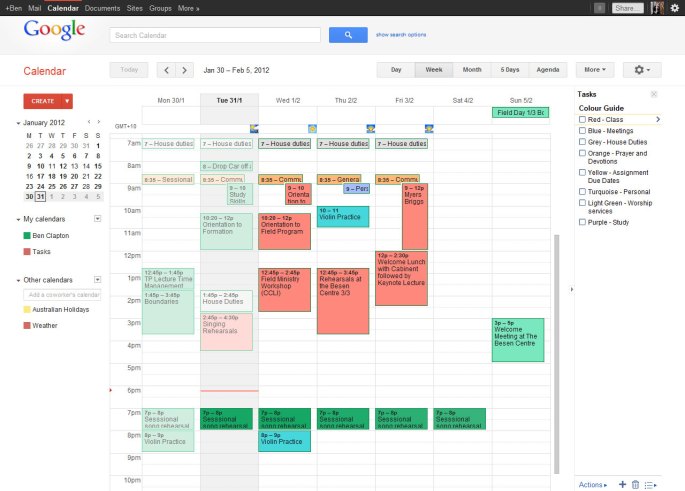
I’ve been in orientation this week for my course, and one of the lectures has been on time management. I’m really wanting to make sure I get organised and ensure that I make good use of my time (especially as there is often limited time), so I’m wanting to make full use of the resources available to me.

I’ve been using Google Calendar for a while now, which is especially awesome as it now sync’s with my phone. However, with everything looking the same, I longed for the ability to look at my week and quickly glance what was class time, what was study time, when assignments were due, and – importantly – when my “personal” time was – the time where I could go and practice my violin, play a game on my computer, or squeeze in a round of golf. Continue reading “Brighten (and organise) your Google Calendar!”

Well, I better have a Well-Being Plan

The Salvation Army Training College, Melbourne

I’ve practically finished my first week of orientation at the Training College. We’ve had a lot of different orientations – to uniform, to education, to prayer and more. Yesterday, we had a session called “Coping with Change”. We have all had to go through a big change in order to come to the Training College. At a very basic level, the shift from Perth to Melbourne was a big change. We were discussing yesterday the differences in language that we share – from Milk Bars and Delis, to Stobie Poles and Power Poles and even the way we pronounce Lego.

One thing we did was to create a well-being plan that focussed on some goals in four areas – Physical, Mental, Emotional and Spiritual. By setting goals in these four areas, we can help take control of certain areas of our life so that we can deal with the change better, but also be in a better mental state. Part of the exercise was to write down some names that we would share the plan with so that we can be accountable with it. So I’m going to share my goals with you, and post regularly on how I’m going. Continue reading “Well, I better have a Well-Being Plan”

Melbourne

Well, Liesl and I have arrived in Melbourne, and are slowly settling in, and realising that this is our home now. We’re staying at an Aunt’s place until Tuesday, so it still feels a bit like a holiday. However, we have done some things that make staying here very much a reality.
For example, one of the first things we did in Melbourne was to search for a new car. We sold our car in Perth, because we had a two door Hyundai Getz, and two door cars aren’t great when you’ve got a baby.

Continue reading “Melbourne”

Farewell

Today is our last Sunday at our Church before we leave. Due to it being January, we actually had our Corps farewell on December 18. Today we will receive a farewell from the Division as well as an “official” farewell from our corps. I thought I’d share today our farewell, which was shared by Mrs Wilson, as well as Liesl’s farewell reply.

Farewell Speech to Ben and Liesl

A few weeks ago Liesl led the devotions at Songster Practice. She spoke about her life being in the ‘count-down’ phase as she was going through ‘the last time I will be doing this’ before leaving WA for the Training College… the half packed boxes a constant reminder that time was ticking away far too quickly. She expressed that her sense of excitement and anticipation was tinged with sadness because she would be leaving her church family here at Floreat. Liesl has grown up in this church since she was a baby, except for a brief period after the family moved to Morley and attended the Corps there. However Liesl’s heart was always at Floreat so she returned and became one of us again where she has been nurtured and encouraged in her faith and service for God. Those who have known Liesl would be aware of her strong conviction that God had called her into full-time ministry in The Salvation Army. Continue reading “Farewell”