The right to become children of God

Incipit Page of the Gospel of John.
The incipit page from the Gospel of John (Image by peterjr1961 via Flickr)

“Yet to all who did receive him, to those who believed in his name, he gave the right to become children of God— children born not of natural descent, nor of human decision or a husband’s will, but born of God.”

John 1:12-13
This is a beautiful passage from the beginning of John’s gospel, that says that all who believe in Jesus, all who accept him and trust in him, have the right to become a child of God, and accept all the inheritance that comes with that, to receive God’s care and protection.

This NIV translation has some interesting changes in verse 13. The NRSV translation of verse 13 reads “who were born, not of blood, or of the will of the flesh or of the will of man, but of God.” They both use the plural, “who were” or “children” as opposed to the singular “who was” which some old translations have. The singular implies that it is only Jesus that this passage is talking about, where as the plural implies that it is talking about everyone that accepts and believes in Jesus. But the next part, skipping the “not of blood” with the NIV translating that as being “not of natural descent” is a nicer translation, if not entirely correct, but it does reduce the chance of confusion. E.C. Hoskyns in his book The Fourth Gospel writes “The Evangelist cannot write that the Christians were not born of blood (singular), because their birth does in fact depend upon a death which later he describes as involving the outpouring of blood.” This depends on whether you believe that salvation comes through the death of Christ, or as this verse seems to imply only through belief in his name. Note that one does not discredit the other, it is all in which way your beliefs take you.

There are many who would say that belief that doesn’t include salvation through the cross makes you not a “real” Christian. To them, I would give this verse, “to those who believed in his name, he gave the right to become children of God.” Personally, I believe that Christ died to forgive our sins as an amazing act of grace. He did this for all the children of God, all those who believe in his name.

A Star Trek Devotional: Encounter at Farpoint

John de Lancie as Q in WWIII/Post-Atomic Horro...
Q as an officer from the Mid-21st Century Wars, from Encounter at Farpoint. (Image via Flickr)

I wanted to try my hand at writing a devotional based on episodes of Star Trek. I am a Trekkie, and I feel there is a lot that we can learn from the various episodes. That I’ll have to watch more Star Trek in preparation for these devotionals is just a happy coincidence. My first devotional is based on the first episode (double episode) of Star Trek: The Next Generation, Encounter at Farpoint.

Continue reading “A Star Trek Devotional: Encounter at Farpoint”

Why does God allow evil in his world?

This topic suggestion, Why is there evil in the world?, is from The Daily Post as part of the Post-a-day writing challenge.

Student: Sir, you are working on the Premise of Duality. You argue there is Life and then there is Death, a good God and a bad God. You are viewing the concept of God as something finite, something we can measure. Sir, Science can’t even explain a thought. It uses electricity and magnetism, but has never seen, much less fully understood either one. To view death as the opposite of life is to be ignorant of the fact that death cannot exist as a substantive thing. Death is not the opposite of life, just the absence of it.

That quote is part of a longer story about an atheist Philosophy lecturer and a student having an argument in class, where the student ends up declaring to his classmates that the lecturer has no brain, because no one in the class has seen, felt, tasted, smelt or heard it. You can read it in full here.

You see, there is evil in this world when people are far away from God. God allows it because he has given us free will. We can choose which way we go. I have this image of God, and all his angels, looking on from above, cheering each of us on to choose the right way, and consoling us when we make a mistake.

Postaday2011 links

Sunday Set List – 24 July

We had our youth meeting last night, and one of our young men, Stephen, preached on the topic “Create in me a clean heart”. Stephen also prepared the meeting lead, and he did an incredible job of putting together a fantastic service. Songs that we had this month:

  • Create in me a clean heart – Phil Laeger
  • Nothing but the blood
  • Men of Faith (Shout to the North) – Delirious?
  • Eagle’s Wings
  • I want dear lord a clean heart
  • O Happy Day (with Daena absolutely rocking out the solo)

It was a good service, and a nice set list. We’ve got the Divisional Youth Secretary coming next month, but before that we’re adding in a “Youth Style” meeting, that our corps officers will be running, but the youth band providing the music. That will happen on the second Sunday, so I’m looking forward to that.

To check out what others are doing in their services and learn more about what Sunday Setlists is all about, check out TheWorshipCommunity.com at http://www.theworshipcommunity.com/sunday-setlists-157/

You can feed five thousand

Jesus is considered by scholars such as Weber ...
A depiction of Jesus, teaching seated. (Image via Wikipedia)

Liesl and I have been asked to lead a service at the York Corps on August 7, and it’s apparently my turn to preach. Now, I’m due to have knee surgery on Tuesday (if I don’t there’s a whole heap of other problems happening, but I’m not going into that), which means I may well be on crutches when we do the service. So I’m planning to preach sitting down. Jesus often sat down while teaching, so why shouldn’t I?

It got me thinking about the times Jesus did sit down to preach, which mostly appear in Matthew’s gospel. This is all because Matthew’s gospel was written for a mostly Jewish audience, where Teachers would teach seated. So there’s the Sermon on the Mount, and the parable of the Sower and the seeds that fall on various ground, but these didn’t seem to grab me. I turned to chapter 14 and read of the feeding of the five thousand.

After this, I read the relating passage in the Tyndale commentary that we were given a while ago and I now have a bookcase to display them so I grabbed this commentary and this little bit sparked an idea.

As the day wore on, the disciples urged Him to discontinue His healing activity and to send the crowds away to obtain provisions before it was too late. Jesus, still moved with compassion for the hungry, shepherdless throng that surrounded Him, decides to use His miraculous power to satisfy their needs. But first He brings home to His disciples indirectly the fundamental truth that he has called them to be shepherds of the new Israel which constitute the Messiah’s flock, but that they will never be able to discharge that function in their own strength. All the power necessary for ‘feeding the sheep’ comes from Him, the chief Shepherd of the flock, and from Him alone. Such would seem to be the significance of Jesus’ words “They need not depart; give ye them to eat.” When they point out that their available supplies, “but five loaves, and two fishes” are totally inadequate for a catering task of such magnitude, He bids them bring their resources to Him; and in His hands they become so wonderfully multiplied that when the disciples receive them back from Him and distribute the broken pieces to the people they are found to be more than adequate for the entire company.

The Gospel According to St. Matthew Tyndale Commentary (General editor Professor R.V.G. Tasker), 1961. Page 143-144
Reading this passage sparked a light in me. When Jesus says “They need not go away; you give them something to eat” (NRSV), he’s telling the disciples that they are able to feed the people spiritually. Yet they aren’t able to see past the physical needs into the spiritual needs. And then as the commentary points out, it is only through Jesus, the “chief Shepherd” that we have the power to feed five thousand people, spiritually, and when we come to him, when we rely on him, we are able to do the seemingly impossible.

So, that’s where my thoughts are at a couple of weeks out from the sermon. We’ll see how they turn out. But for now, a question for you to think about: Do you think you could feed five thousand? If not, how many could you feed?

As we forgive those who sin against us

This topic suggestion, Why is it so hard to forgive?, is from The Daily Post as part of the Post-a-day writing challenge.

Father, forgive us, as we forgive those who have sinned against us.

Forgiveness is not always easy. At times, it feels more painful than the wound we suffered, to forgive the one that inflicted it. And yet, there is no peace without forgiveness. It is easier to forgive an enemy than to forgive a friend, But I forgive you (Image from Flickr by bija1agape. Quote from Naj on Flickr)

A line that so many Christians will know so well, coming from the Lord’s Prayer. As with many aspects of Christianity, it can often be much harder to live this out than it is to say. As such, we often hold onto sin long after it has occurred.

For example, I held onto a sin against me for many years. After being bullied in year 11 and 12, I refused to go near the school for a couple of years. While the school itself had done nothing wrong – in fact it did everything it could to help me through the period – I held onto that sin, I held it against the school. Continue reading “As we forgive those who sin against us”

Can a camera capture a moment in time?

This camera shot captures a beautiful moment in time, the spray most likely never being exactly like that ever again.

This topic suggestion, Can a camera truly capture a moment in time?, is from The Daily Post as part of the Post-a-day writing challenge.

Despite being a fantastic question, with many philosophical possibilities and questions, I had to write on this topic, because it was suggested by Leonard Nimoy, who for those who don’t know is most famous for his work in my favourite show – Star Trek – as Mr Spock, who tweeted:

http://twitter.com/#!/LeonardNimoy/status/1150300359

Now, I think this is more kind of getting into the realm of philosophy and I’m not really a philosopher, but I’ll give it a try.

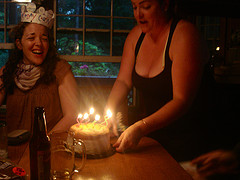
The pure joy in this persons face as their birthday cake is brought out is captured here in this moment of time

I think that a camera can capture a moment in time, even though it cannot capture itself. Why? Because a moment in time I think doesn’t have to be a 360° 4-dimensional representation. A camera has the ability to capture incredible moments in time that sometimes can truly reflect a beautiful moment in time.

Postaday2011 links

Window or aisle, I’m breezy

I'm concerned the plane for my flight tomorrow...
A9, D10, I might pass on F12 though. (Image by Leia via Flickr)

This topic suggestion, Do you prefer the aisle or window when travelling? Why?, is from The Daily Post as part of the Post-a-day writing challenge.

I apologise for the bad pun in the title, but I couldn’t resist.

I can’t say I’ve travelled much in a plane, however, my experience has told me that I don’t really mind where I sit, aisle or window. However it does depend on the flight.

There’s something nice about being able to look out the window as you’re flying into somewhere new. Being able to look out and view this city that you’re going to spend the next little while exploring. Likewise, looking out over your home city as you return, seeing the suburbs, the landmarks that make you love the place where you live and call it your home.

However, if the flight is a long one – such as 5 hours or more – I might be willing to pass that up for the possibility of walking around. 5 hours is a long time, and if the person next to me falls asleep, and I need to get out, I don’t want to wake them or climb over them – hence the aisle is better for the longer flights.

Overall though, I don’t mind too much. You can see through a window for landing where ever you sit, and the rest of the time I generally spend reading or playing on my laptop, so I’m not fussed over where I sit.

Postaday2011 links

Divine intervention and free will

This topic suggestion, They say “everything happens for a reason” – do you think this is true?, is from The Daily Post as part of the Post-a-day writing challenge.

I was asked by a friend on Facebook recently what my thoughts were on whether everything was planned or whether there was the possibility of coincidence.
I believe that God is omnipotent, knowing everything that has happened, is happening and will happen. He has a plan for our lives: “for I know the plans I have for you, declares the Lord.” However, God also have us Free will. He gave us the ability to choose for ourselves. My picture then is of God watching a sporting match. While he knows the result, he’s there, surrounded by all his angels cheering us on, rejoicing when we choose the right path, and consoling us when we make a mistake.
Does that leave any room for coincidences? I think so. I’ve heard the phrase “god-incidence” used to describe those situations where it could only have been influenced by God. I truly believe these happen.

So does everything happen for a reason? For has a plan for our lives – it’s up to us whether we follow that plan.

Postaday2011 links

Refreshing

This topic suggestion, Weekly Photo Challenge: Refreshing, is from The Daily Post as part of the Post-a-day writing challenge.

Refreshing Water (image by Daniel Go on Flickr)

In our lives, there are certain areas that sometimes need refreshing. However, far too often, we will find ourselves caught up in the business – or busy-ness – of living, and won’t give time to refresh ourselves. Here’s a few things I sometimes do to refresh different areas of my life. Continue reading “Refreshing”