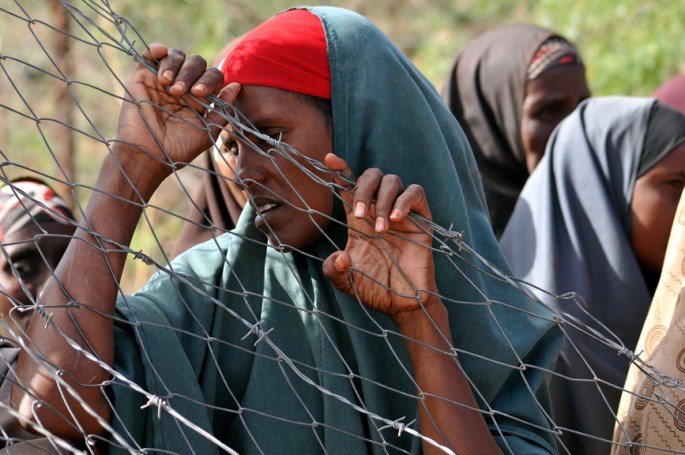
Yes, we’re hearing reports of people traumatised by lack of access to drinking water, injured in riots, held in detention with nothing to do and little hope of a future reunited with their families.
And yes, I’ve seen the graphic novel on the Immigration Department website – the one depicting despairing young men cowering under the shadow of the Australian military. I’ve seen the pictures that reveal a trip to Australia by boat to be a ticket to a world of suffering. We look menacing. We look cruel.
It’s pretty awful. I don’t deny it. BUT IT IS WORKING. The boats are stopping. The message is getting through.
No more lives are being lost at sea and surely that makes the tough measures worthwhile. Because sometimes you have to be cruel to be kind.
This is the message that’s out there in the Australian community, shadowy…
Our God, Our God,
we have hit a low point in our nation.
In our fear, we have put people in situations
where they have faced the very thing they were fleeing.
In our fear, we have caused people to be hurt, we have caused people to die
and blamed it on the very people who were hurt.
In our fear, we will try to explain it away,
they came here the wrong way, they shouldn’t have protested
they brought it on themselves.
Lord God, shine a light on our misdeeds.
Help us to see that our actions born out of fear
feed only that fear, and do not offer the protection that only you can give.
Father God, protect those who are in need of protection.
Heal their injuries, and keep them safe from further attacks.
Loving God, accept us with all our frailties,
the mistakes that we have made
the mistreatment that we have endorsed
and the times when we stayed silent when we should have had a voice
to speak for those who had no voice.
Blessed are you, O God, who accepts us all
Praise be to the Father and the Son and the Holy Ghost
Who is above all, in all, and through all things. Amen.
This prayer of lament was written by Ben Clapton, Salvation Army Officer, musician and activist, in response to the reports of violence at Manus Island. I release this to be used in any manner, as long as the entire text remains in one unit, and a reference to this post is included.
I’ve been feeling a lot of hurt over the reports coming out from Manus Island. Last year, at this time, I was over on Manus Island. While it is my understanding that the families are no longer on the Island, I believe that many of the men that I met are still there. I don’t know if they’re ok, or whether they’re part of those who have been injured – and I’ll probably never know. It pains me that our government put these people here, and have not done enough to fully protect them, in the name of protecting us. I know that I am, at times, guilty of not speaking up, feeling tired and not knowing whether my voice really adds anything. This fight has gone on for far too long. My prayer is that this tragic event, which I wish had never happened, might draw us as a nation into focus, and realise that our actions and the path we headed down was wrong, and that we would repent of our actions as a nation, and set up a process to assess the claims of asylum in a timely and humane manner.
I was putting together my lead for this Sunday’s meeting, and a thought came into my head that the song, “In Christ Alone” might be a song worth considering. If you don’t know it, here’s a version by Owl City (of Fireflies fame)
Now, this song has come under a bit of scrutiny in the past because of its lyrics. Last year, the Presbyterian Church of the USA wanted to include this song in their new hymnal, but decided not to because they were unable to change one of the lines of the song in verse 2. The original verse reads
’Til on that cross as Jesus died
the wrath of God was satisfied
Where as the altered version they wanted to use read
‘Til on that cross as Jesus died
the love of God was magnified
And to be honest – the change isn’t a bad one. I think it fits doctrinally, biblically and personally I’m more than happy to focus in on the Love of God (which is very evident in the New Testament) as opposed to the Wrath of God (which is very evident in the Old Testament). However, the original lyrics also work, they are sound, and they also have powerful meaning. When the Getty’s decided not to allow the change, they were well within their right to do so, and for me this issue isn’t a deal breaker.
However, I’m uncertain as to whether to use this song or not. My doctrinal issue with the song comes in the last verse.
No pow’r of hell, no scheme of man
can ever pluck me from His hand
Now the issue here comes with the ninth Doctrine of The Salvation Army:
We believe that continuance in a state of salvation depends upon continued obedient faith in Christ.
Commonly known as the doctrine of backsliding, this means that as Salvationists, we believe that in order for you to remain in a state of salvation – that is saved by Jesus Christ – you need to continue to have obedient faith in Christ – that is, faith that follows the teachings of Jesus Christ. The flipside of this is that if you stop having obedient faith in Christ, then you lose your state of salvation. There’s no “once saved, always saved” here in the Army. Once saved, you need to keep being faithful to God.
And that’s where the issue lies. For Salvationists, if you stop having faith, then you are effectively plucked from his hand, to use the imagery from the song. Where the song states that there is nothing on the earth or below it that can remove our state of salvation, our Doctrines state that there is in fact a situation where we can lose our salvation.
That being said, there is a different way of reading those lyrics. You could argue that in fact, the line is stating that because my faith is so strong, because I have my continued obedient faith, that there is now nothing that can remove my state of salvation. But it’s a bit ambiguous.
And my problem is that I love the song – the melody is fantastic, the rest of the lyrics are so incredibly powerful, and such a grand statement. But can I, as an officer who is to proclaim The Salvation Army doctrines as the defining articles of our faith, use a song that has one single line that speaks against one of our doctrines?
This is the beauty of our Songbook. When we choose songs from there, we are guaranteed that the lyrics are doctrinally sound to The Salvation Army Doctrines. There have been people – far smarter than myself – who have gone through and analysed, and worked out whether the song can be used or not. I’m certainly looking forward to the release of the new songbook, hoping that it might have a few more recent worship songs which will make planning a meeting easier. When we move away from the songbook – as many corps are doing in order to stay relevant – we need to give at least a bit of a thought as to whether the songs we choose meet the standards set by our doctrines. If not, we have an obligation not to use them in our meetings, because as officers we are to proclaim the Gospel and uphold our doctrines.
So until I am suitably convinced otherwise, unfortunately, I cannot use this hymn, as much as I love singing it. Now I best get back to choosing that final song for Sunday’s service.
What do you think? Does one line mean that we shouldn’t sing this song? Is there a strong argument that means that it can be used in a Salvation Army context? or am I just overthinking things?
I was reminded by a friend’s Facebook post of an odd practice by some churches where they get newcomers to stand up, and the church welcomes them with applause. It got me thinking about the different ways we welcome newcomers – from welcome lounges to welcoming them by name, welcome packs to an invitation to the pastor’s house the following Sunday for lunch (and a guaranteed 2nd visit). Some of them can be pretty confrontational, particularly if the visitor isn’t certain whether they’ll return next week.
Yet, there is this sense of urgency in welcoming a new visitor to your church. We want to welcome them, the thought being that if they feel welcome then they will be more welcome to return again, and perhaps become a member. But if we come off too eager then we will scare them off with our welcoming. A tough line to tread.
This post has no answers, but I’d love to hear what your church does. At Devonport Salvation Army, we have a welcome pack which we offer visitors, which includes a book, some information about our programs, and some chocolates. I don’t know how well this works yet, but it’s what we have. I’d love to hear how your church welcomes new people, and as a challenge, why don’t you go to another church and see how they welcome you!
As has been my tradition, every sermon that I preach will be posted here. This sermon, Living lives of love, was given at Devonport Salvation Army on Sunday 16 February, 2014. The Bible reading wasMatthew 5:17-37.
I wonder what your families were like when you were growing up. Were there any topics of conversation that you didn’t talk about? Maybe football was completely off the table – bring it up and you’d get sent to your room. Or maybe it was politics, or religion. In my Dad’s family, the taboo topic was divorce. You didn’t talk about it when my grandparents were in the room – it just wasn’t done. And I don’t know why, because it was the sort of thing that, while we did ignore it, it didn’t ignore our family. In fact, the only one of my Dad’s family who hasn’t got divorced is my Dad. All this in a family where Divorce just wasn’t talked about. Looking back, I would say that the divorce was a good thing for all of my aunties and uncles. So when I look at today’s reading, and I read Jesus speak out so harshly against divorce, I have a bit of trouble accepting that. I’m not saying that I advocate divorce – I think it’s a shocking indictment on the church that there are just as many divorces within the church as there are outside of the church – but I feel like there must be more to this passage than the first, initial reading. Continue reading “Living Lives of Love”→
“More than anything, this truly is the living word.”
How many of you believe everything that you see on TV? What about everything that you read in the newspaper? What about everything that you read online? Because if it’s on the internet, that makes it true doesn’t it? How many of you believe what is written in the Bible?
As has been my tradition, every sermon that I preach will be posted here. This sermon, Being a Light to the Community, was given at our Installation service at Devonport Salvation Army on Sunday 12 January, 2014. The Bible reading wasMatthew 5:13-16.
I don’t know what you’re thinking about me right at the moment, but one thing that I can tell you is that I’m a bit of an odd person, and I like odd things. My wife won’t disagree here. I like Star Trek and Lord of the Rings, and I play musical instruments with strings, not brass. Before I went to the Training College, I spent 18 months in the Media and Communications department at the Uniting Church Synod office, where I did, amongst other things, a lot of looking at and editing photos. One thing that I learned to appreciate was the different types of light. Continue reading “Being a Light to the Community”→
In his inaugural speech, Nelson Mandela, the first president of a free South Africa, told his people and the world:
We understand it still that there is no easy road to freedom.
We know it well that none of us acting alone can achieve success.
We must therefore act together as a united people, for national reconciliation, for nation building, for the birth of a new world.
Let there be justice for all.
Let the be peace for all.
Let there be work, bread, water and salt for all.
Let each know that for each the body, the mind and the soul have been freed to fulfil themselves.
Never, never, and never again shall it be that this beautiful land will again experience the oppression of one by another and suffer the indignity of being the skunk of the world.
Let freedom reign.
The world is waiting to see what this generation is going to do. The children whose lives are in the balance are waiting for you to act on their behalf. Your own future children are already waiting to see what kind of world you will give them. The Church is waiting for you to change our direction. Most of all, Jesus is waiting for you, waiting where he lives amid the sufferings of humanity, waiting for you to join him there. Are you ready? We need you now. This is your time and your moment. Don’t let it pass you by.
So my advice is to take care of your faith, take care of each other, take care of your hope, and stay with your vision.
And my commission to a new generation is this:
No longer accept the unacceptable.
Change what is believed to be possible.
And always make the choice for hope.
— Jim Wallis, Seven Ways to Change the World, p. 242-243
Scott Garber, the pastor of our Washington Community Fellowship, says:
Racism does not just disappear just because of the passage of time. Racism does not disappear just because we are sorry. Racism does not disappear just because we’re “workin’ hard”. Racism doesn’t disappear just because we denounce it. Racism doesn’t disappear just because we change our laws. Racism doesn’t disappear just because we compensate for its consequences. Racism doesn’t disappear just because we build a memorial to Martin Luther King. Racism, like any other sinful condition that God does to transform, will disappear when, and only when, it is replaced by its opposite.
What is the opposite of racism? Well, racism involves attitudes of superiority and inferiority. So, transformation means replacing those attitudes with equality and love and meekness and affirmation. And racism involves social systems characterized by stigmatisation and oppression of those we perceive as different. So, instead, a just society must create a community defined by mutual submission and solidarity, protection and opportunity… At this juncture in the history of our nation God is looking for a model home for his transforming kingdom values – a staging ground for the opposite of racism. To prove that such a transformation is possible and to show what it looks like.
To do that, the church will have to commit itself to both truth-telling and a direct engagement that goes far beyond just denouncing racism. Pastor Garber says we have to first be honest about what the role of the church has been and yet insist upon what that role now should be. He confesses, “Historically, despite some noble exceptions, the church has Allentown prostituted is theology to the institution of slavery, looked the other way during decades of discrimination, stashed is feet through the civil rights movement, ignored the problem one the external stimulus was removed, and finally settled for something resembling ‘separate but equal’ in church life. It’s hard to be part of the problem and part of the solution to the problem at the same time. And, yet, God still desires to display his transforming power through the church.” For that to happen, Garber says that the church must “turn the bright lights of righteousness on the sin of racism.”
— Jim Wallis, Seven Ways to Change the World, p. 152-153
I’ve restarted reading a book that I started a little while ago, and it reminded me of a problem that I picked up the first time, which was the use of proof texts. For those that may not be familiar with the term, a proof text is the practice of extracting a verse or couple of verses from the Bible in order to prove your point. What happens is that the verse is often stripped of its context, and as such may not actually mean what it is being said to mean.



 There. I said it.

