
Recommending Christianity

I recently commented on a post on an Atheist’s blog. She went to a Multi-Faith forum, where she discussed Atheism, and got offended by some of the Christian’s comments. And fair enough – the Christian speaker practically described atheists as “rebellious cranky kids who want to be able to run around having promiscuous sex and drunken parties.” In reality, Atheists are people who have seriously thought about their faith and their beliefs, and often have thought about God more than most Christians. As I commented on her blog, I’m not going to get into trying to Convert them there, because it’s not the place.

But a comment following on from my comments got me thinking. Commenter Andre said “You achieve no tangible results by attempting to convert people, and it is frankly crass, disrespectful, and downright insulting.”

Maybe it is. I know for me, I get a little bit annoyed when people try to convert me to another religion. So when talking about our faith with non-believers, should we consider a different tactic?

Christianity as a Band

A long time ago, a friend of mine told me to check out his Cousin’s band, Sounds Like Chicken. We had a listen to the CD, but it didn’t really grab me, so I left it alone. A little while later, while in the local Christian book shop, Koorong, I saw their next EP and thought that I’d give it another go. I had a listen and heard songs such as this one:

I really liked the CD, and started to get into them. Every time they came to Perth, I went and saw them, and really got into their music. They were (and still are) my favourite band, but have since broken up to pursue other avenues.

When we recommend a band to someone, or a movie, we’re telling them that we’ve discovered something we really like, something we’re passionate about, and we think that they might like it as well. If they don’t, that’s cool – we know that everyone has different tastes in their music, and movies, so that’s fine. But also, just like I eventually decided that I loved Sounds Like Chicken, even though I wasn’t really taken by them when I first heard them, we may later rediscover a band and decide that we now like their music, where as we didn’t before.

I feel that sometimes, we need to recommend Christianity much like we do music – especially when we’re amongst our friends. Be willing to tell people about this really awesome thing you’ve discovered – Christianity – but don’t be offended if they’re not interested in it. They may have different values. They may be in a different situation. As is often said – the seed has been planted, and though we don’t know how long it will take to grow into fruition, or even if it will survive, so long as we are planting seeds, the possibilities remain. And remember to allow the recommendations to rest if someone dislikes it. I know for me, the more someone continues to tell me something I don’t like, the more I dislike the idea, and sometimes the person.

For example, I was watching Sunrise one moring, and Howard Sattler, a talkback radio presenter for 6PR in Perth was discussing asylum seekers who arrived by boat. He was saying that we should send all the “illegal” arrivals back to where they came from, despite the fact that Australia has a legal obligation to assess all asylum seekers cases who arrive in Australia under the UN Refugee convention, and that if they are legitimate Asylum Seekers then sending them back to their home country would place them in more danger than they were originally in. The more Howard spoke, the more I disliked his idea, and the more I disliked him – to the point that I’ll switch off if he is on Sunrise now. Likewise, if someone is not interested in Christianity – the more we push it, the less interested they get.

Instead, convert with your actions. Live your faith, in every aspect of your life. People will see how you live and wonder “what makes them so different?” My beliefs brought me many opportunities to talk about my faith on Tour. Because I wasn’t drinking, it gave rise to a number of questions as to why. While I may not have pushed conversion on them, just by talking to them lets them know about Christianity – and the seed is planted. What they do with that seed, that is for the Holy Spirit to work on – whether through myself, or another person, or through the person themselves. The important thing is that we show respect, and not be, as Andre put it, “crass, disrespectful and downright insulting.”
A Christian Gamer’s Guidelines

I’ve been thinking more about the post I wrote a little while ago entitled “A Christian Gamer” where I walked through some of the issues I was being challenged with at being a Christian, and a gamer, and how to reconcile those things. With most of the games that I play at LAN’s being violent games, how was I to reconcile that with my views as a Christian. And when you take into consideration the Salvation Army’s reasons to abstain from Alcohol, Cigarettes and Gambling because it harms other people (as well as yourself), how can I reconcile my gaming, which appears to harm some people?

As I have been thinking about it, I have decided to come up with some “Guidelines” – I don’t want to use the word Manifesto or Creed, as these are not necessarily beliefs. These guidelines are just some observations that I want to use to try to shape my gameplay into a more Christian role.

Firstly, I would call my beliefs Moderate to Liberal. I don’t believe that we should abstain from everything that is not in the bible. I feel that there are Christians who take what is written in the bible so seriously that it scares people away from Christianity. Yes, I believe the Bible is the word of God, and that we should read it, and embrace it, and know it fully (something that I am still striving to achieve), but I also believe that we need to read the bible in context – in the context of when it was written, and the context of how we apply it today. I believe that in reading the bible in the context of today, how we apply it to our lives, we must be willing to step back, and take a more general look at the meaning of the passage, of the chapter, of the book, and of the Bible in general.

With that in mind, here are my guidelines.

1. Get my priorities sorted.

Love the LORD your God with all your heard and with all your soul and with all your strength.

Deuteronomy 6:9

I have heard, in relation to becoming a priest, that your priorities should be “God First, Family Second, Church Third.” This way, you serve God, you provide for your family, and then you look after the church. It’s a matter of determining where your priorities lie, what you feel is important. This is reflected in the scripture above. Jesus said that this was the great and first commandment. Love God first, then your family (Ephesians 5:25; Proverbs 22:6), then the Church (Galatians 5:13). For me, while I enjoy Gaming, it shouldn’t come at the expense of more important things. If I haven’t spent time with God today, then surely my time can be spent better than playing some game. If I haven’t spent time with my family, then gaming surely can wait.  This then leads onto the second guideline:

2. Don’t  Get Obsessed

You shall not make for yourself an idol in the form of anything in heaven above or on the earth beneath or in the waters below. You shall not bow down to them or worship them; for I, the LORD your God, am a jealous God

Exodus 20:4-5a
I have heard all too many stories of people becoming obsessed with games, particularly MMORPG’s such as World of Warcraft. I have even heard of Game Addiction Rehab Clinics in places such as Amsterdam. If I am not careful, I could be drawn into these games, and not realise it. Therefore I must remain vigilant so as not to become obsessed. Exodus 20:4 talks about false idols. In the context of the day, these were idols, statues that the people would make and worship, believing them to be gods. But in today’s society, our idols are much more secluded in nature. We don’t have physical golden idols, but we do have TV, computers, magazines, celebrities – things that take our focus away from God. The first guideline helps with this, ensuring that I remain focused on God and Family. I will never rush home to play my game (this includes searching for a computer because I forgot to water my Farmville farm – which won’t be a problem as I don’t play that).

3. Game in Community

Now we ask you, brothers, to respect those who work hard among you, who are over you in the Lord and who admonish you. Hold them in the highest regard in love because of their work. live in peace with each other. And we urge you, brothers, warn those who are idle, encourage the timid, heal the weak, be patient with everyone. Make sure that nobody pays back wrong for wrong, but always try to be kind to each other and to everyone else.

1 Thessalonians 5:12-15
One of the great things about gaming is that it brings you into a community. For me, I have a group of about 4-5 friends that meet up semi-regularly to play. For some of these guys, they might not go to Church regularly. By gaming with them, it opens up opportunities to chat with them about Christianity, and also to maybe invite them along to church one day. Gaming by yourself is fun sometimes, but that community aspect is one of the real joys of gaming. At the end of Paul’s letter to the Thessalonians, he gives the final instructions above. It all boils down to respect in your community. Verse 14 says “And we urge you, brothers, warn those who are idle, encourage the timid, help the weak, be patient with everyone.” For me, in relation to gaming, this verse is vital. For in community, we can chat to others about their issues, we can encourage the timid, be patient with everyone. We can make sure that nobody pays back wrong for wrong, and try to be kind to each other and to everyone else (Verse 15). It is in community that we can follow God’s word. Hence, when we game, as often as we can we should try to aim to do so in community.

This also goes into helping others make sure that they don’t get obsessed with their gaming. Remember, the reason why this issue spoke to me was because there are people out there who are affected by games. People who do get obsessed, who can’t distinguish the difference between a video game and real life. By gaming in community, we can look out for the signs of these people, and – as Paul writes – “help the weak,” we can help them through any issues that they have, either through a chat, through possibly bringing them to Christ, or through getting them in contact with people who can help.

Conclusion

As I said, these are by no means a manifesto or creed – just some guidelines. So I would encourage others to suggest things that I might like to include. I haven’t tackled in this edition what games to play, as I feel that by following the above guidelines that it’s not so necessary – but perhaps you disagree. Does “Thou shalt not murder” include killing in video games? Comment. Discuss. I’d love to hear your thoughts.

Easter Camp 2010

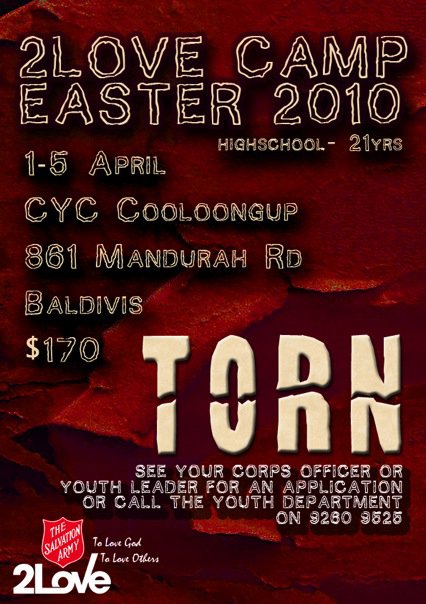
Easter Camp 2010 Poster

Over the weekend, I had the amazing blessing of being a leader on the Salvation Army Easter Camp. Running from Thursday Night until Monday Morning, we had an awesome time having fun, learning about God, and making new friendships. The theme for the weekend was Torn, based on the part of the Gospel story that when Jesus died on the cross, the curtain of the temple that shielded the Holy of Holies was ripped in two from top to bottom. Continue reading “Easter Camp 2010”

Has Twitter decreased our Internet Safety?

There is no doubt that Twitter has taken the world by storm. The micro-blogging phenomenon has led us to communicate more to whoever is listening about anything and everything. Most major TV events will have twitter abuzz, there are even some TV shows that will hit the twitter top trends when shown in the US.

However, with the increased use of Twitter, has this lead to a lapse in Internet Security practices?

My main concern is the use of shortlinks, or URL Shortening Services. These have sprung up over the last year or so, and now there is a large number of these services out there – and often you can run one from your own website with very little technical knowhow. Even WordPress has one now, so that this page address which is

http://benclapton.id.au/2010/01/19/has-twitter-decreased-our-internet-safety/

becomes:

http://wp.me/pve12-55

Much shorter, and easier to put into a twitter message of 140 characters.

However, has this service made us lapse about our own personal internet security practices? Continue reading “Has Twitter decreased our Internet Safety?”

Prayer

I was recently on an orchestral tour which ended in tragedy, with the death of a tour member and the hospitalisation of another. I’m not going to go into details, but I’d like to share some thoughts.

We were called down to the lobby around 6.40am, being told an accident had occurred. After we were told the news, we were told to call our parents to let them know we were ok, as names had not been released. At that point, I realised that the only thing I could do was pray. I had a quick prayer in the lobby, then headed up to my room to call my parents and fiancee. I then sent a message to a number of people in Perth, asking them to pray. I then prayed myself.

For about half an hour, I prayed forhealing for the boy still in hospital, I prayed for the boys families, I prayed for everyone on tour. Over the course of the day, I felt God’s arm around me continuously, feeling strongly his presence with each prayer sent his way from Perth.

I would pray often through that day, each time feeling a strong sense of peace through Christ.

It cemented in my mind that prayer works. Whether petitioning for healing, or other concerns, or just entering into communion with God, prayer can have incredile effects – sometimes what we want, sometimes what we need, sometimes an answer in a different form.

I will continue praying about this event, and would ask that you do as well.

I hope that you all had a wonderful Christmas, remembering the real reason for the season – Christ was born, who came to die for our sins so that we can have a full relationship with God.

A Christian Gamer?

I’ll freely admit that I’m a bit of a nerd. Actually… a lot of a nerd. And what do nerds do to have fun with friends? Game. I’m what you would call a casual gamer – I don’t really play computer games all that often by myself, but will generally try to get to a LAN at least once a month with a few mates to have a gaming session. What we play at these nights are often an RTS – Real Time Simulator – such as Supreme Commander, Red Alert, or Warcraft 3 (if we’re feeling old school) and a FPS – first person shooter – such as Unreal Tournament 3, Left 4 Dead, Call of Duty, etc. We’re all mature gamers – I’m the youngest at 23 – and I don’t think that any of us would be affected by the violence of such games.

However, I’ve been challenged in my thinking just recently. It was all sparked by the refusing of classification in Australia of Left 4 Dead 2. I was discussing this with my mum, arguing that I felt we needed an R18+ rating for games, especially considering that the average age of gamers in Australia is towards the mid-20’s and growing older all the time. I was saying that the people of are affected badly by violence in video games are in the minority, and generally have some underlying mental illness. My mum then used an argument on me that I had used to help me understand some new commitments in my faith. Continue reading “A Christian Gamer?”

Global Poverty

Biblical Truth

Do not mistreat an alien or oppress him, for you were aliens in Egypt. Do not take advantage of a widow or an orphan. If you do and they cry out to me, I will certainly hear their cry. My anger will be aroused, and I will kill you with the sword; your wives will become widows and your children fatherless. If you lend money to one of my people among you who is needy, do not be like a moneylender; charge him no interest. If you take your neighbor’s cloak as a pledge, return it to him by sunset, because his cloak is the only covering he has for his body. What else will he sleep in? When he cries out to me, I will hear, for I am compassionate.

Exodus 22:21-27, Faith in Action Study Bible

Musical Offering

Ben’s Offering

In September 2000, world leaders came together at United Nations Headquarters in New York to adopt the United Nations Millennium Declaration, committing their nations to a new global partnership to reduce extreme poverty and setting out a series of time-bound targets – with a deadline of 2015 – that have become known as the Millennium Development Goals. There were three goals related to eradication of global poverty:

  1. Halve, between 1990 and 2015, the number of people whose income is less than $1 a day.
  2. Achieve full and productive employment and decent work for all, including women and young people
  3. Halve, between 1990 and 2015, the proportion of people who suffer from hunger

It is sad still, that in 2008, 80% of the world’s population lived on $10/day, and half the world’s population lived on $2.50/day.

Find out more: Check out the UN’s Millenium Development Goals, and write to your local MP, asking what they are doing to ensure that they meet the 2015 deadline.
Edit: 16 Oct, 7.35pm. Forgot the Video. Now included. Wonderful song, People Need the Lord

Jane’s Story

Biblical Truth

Coming down off the mountain with them, he stood on a plain surrounded by disciples, and was soon joined by a huge congregation from all over Judea and Jerusalem, even from the seaside towns of Tyre and Sidon. They had come both to hear him and to be cured of their ailments. Those disturbed by evil spirits were healed. Everyone was trying to touch him—so much energy surging from him, so many people healed! Then he spoke:

   You’re blessed when you’ve lost it all.
   God’s kingdom is there for the finding.
   You’re blessed when you’re ravenously hungry.
   Then you’re ready for the Messianic meal.

   You’re blessed when the tears flow freely.
   Joy comes with the morning.

Luke 6:20-21, The Message

Musical Offering

Ben’s Offering

Jane’s Story

Jane’s* father left when she was three years old.Years later her mother began seeing someone who Jane fought with all the time and at age 14 she was told to leave home. Jane stayed with some relatives for a while until an uncle tried to sexually abuse her, and no one in the family believed her when she told them what had happened. She dropped out of school and began ‘couch surfing’ from one friend’s house to another and met some new friends who introduced her to drugs and alcohol. For the next few years Jane moved between friends’ houses and hostels. Looking back, Jane sees that lots of people tried to help her but either they didn’t know how or she wouldn’t let them. When Jane arrived at YASS she smoked cigarettes, drank alcohol and had taken speed, ecstasy and marijuana. She had been sexually abused twice and was very distrusting of adults. For the first few weeks Jane “sussed out” the staff, looking for ways of affirming that adults were untrustworthy.

After a while she began to notice that the staff genuinely cared about the young people at YASS. They cared about her story and cared for her as an individual. The more of her story that Jane told the more staff were able to help her. With their help Jane stabilised her life and stopped taking drugs and smoking. She began to re-establish some family relationships and discovered that she had a whole other side of her family living in NSW, including a younger sister, who were very interested in meeting her.

Jane couldn’t afford the fare but YASS staff managed to get her a free flight through a corporate sponsor. They found her some temporary accommodation within an hour of where her family lived. Since then Jane has found long term accommodation, is studying full-time at TAFE and working part-time in a café. She volunteers at her local youth centre and wants to become a youth worker.

* Not her real name.

Homeless Young Australians: Issues and Responses, Mission Australia

Donate

UnitingCare Australia is an agency of the National Assembly of the Uniting Church in Australia (UCA). They represent the UCA’s network of UnitingCare community services of which there are over 1,300 service delivery sites nationwide.

The UnitingCare network is one of the largest providers of community services in Australia, providing services to more than 2 million Australians each year, employing 35,000 staff and 24,000 volunteers nationally. It provides services to older Australians, children, young people and families, Indigenous Australians, people with disabilities, the poor and disadvantaged, people from culturally diverse backgrounds and older Australians in urban, rural and remote communities.

You can donate to any of the State Branches: in Western Australia, South Australia, New South Wales and ACT, and Queensland (Donate to one of the service agencies)

Invite the Misfits

Biblical Truth

  Then he turned to the host. "The next time you put on a dinner, don’t just invite your friends and family and rich neighbors, the kind of people who will return the favor. Invite some people who never get invited out, the misfits from the wrong side of the tracks. You’ll be—and experience—a blessing. They won’t be able to return the favor, but the favor will be returned—oh, how it will be returned!—at the resurrection of God’s people."  That triggered a response from one of the guests: "How fortunate the one who gets to eat dinner in God’s kingdom!"

  Jesus followed up. "Yes. For there was once a man who threw a great dinner party and invited many. When it was time for dinner, he sent out his servant to the invited guests, saying, ‘Come on in; the food’s on the table.’

  "Then they all began to beg off, one after another making excuses. The first said, ‘I bought a piece of property and need to look it over. Send my regrets.’

  "Another said, ‘I just bought five teams of oxen, and I really need to check them out. Send my regrets.’

  "And yet another said, ‘I just got married and need to get home to my wife.’

  "The servant went back and told the master what had happened. He was outraged and told the servant, ‘Quickly, get out into the city streets and alleys. Collect all who look like they need a square meal, all the misfits and homeless and wretched you can lay your hands on, and bring them here.’

  "The servant reported back, ‘Master, I did what you commanded— and there’s still room.’

  "The master said, ‘Then go to the country roads. Whoever you find, drag them in. I want my house full! Let me tell you, not one of those originally invited is going to get so much as a bite at my dinner party.’"

Luke 14:12-24, The Message

Musical Offering

Ben’s Offering

From a Salvation Army Media Release, dated 9 July, 2009.

The Challenge to Slash Homelessness by 2020

The Salvation Army welcomes the release of state and territory Counting The Homeless 2006 reports today by the Australian Institute of Health and Welfare. These provide the benchmark data for the efforts required to address homelessness in Australia.

The Australian Institute of Health and Welfare’s Counting the Homeless 2006 reports were co-authored by Associate Professor David Mackenzie from the Institute for Social Research at Swinburne University and Associate Professor Chris Chamberlain from RMIT using 2006 Census data, data on users of SAAP services combined with data from a national census of homeless students. Australia is unique amongst Western countries in having good data on the homeless population and on service usage.

Homeless has remained at about 100,000 persons – men, women and children for a decade and in the past period little priority was given to addressing this issue. Some 30,000 units of public housing were lost and real funding for homelessness services steadily decreased. At a time when Government revenues were recording unprecedented surpluses and unemployment reached a fifteen-year low, homeless people were not able to benefit nor was public money invested in the issue.

The Rudd Government has given homelessness a high priority on its social policy agenda. The White Paper released in December, 2008 by Minister Tanya Plibersek was a landmark document with strong policy positions. However, the global financial crisis has caused huge dislocations in the international economic system and unemployment rates are beginning to rise. Reports are coming in of disadvantaged people being especially affected.

The number of rough sleepers in the inner-city areas of capitals throughout Australia has increased, with the exception of Melbourne, along with the number of children 12 years and under and elderly people 65 and older.

Young people (aged 12 to 25 years) are a significant group in the homeless population on census night – 32,444 individuals in total. The good news is that the number of homeless teenagers on their own has decreased by some 21% from 2001 to 2006 and this is attributed to the impact of early intervention. However, over the same period the number of homeless families increased by 17 per cent. There were 2714 homeless children under 12 in Victoria on census night 2006 – compared with 2618 in 2001 – an increase of 7 per cent. During 2006-2007, the AIHW report Homeless people in SAAP for Victoria reported that 20,500 children had accompanied a parent(s) who were clients of SAAP services.

The Salvation Army is committed to working with the Commonwealth and State Governments to develop effective responses to homelessness. We are particularly concerned about the growing numbers of homeless families. The Global Financial Crisis and the crisis in supply of affordable housing impact this group significantly. It is imperative that we develop early intervention strategies to prevent more families becoming homeless and that interim housing options are put in place for those who lose their homes.

The bold targets set in the Rudd Government’s Homelessness White Paper are achievable but can only be realised if community groups, local communities, corporate and government work collaboratively at the local level to prevent people becoming homeless and respond quickly and appropriately to those experiencing housing crisis. These Census figures assist us to confront these challenges.

The Challenge to Slash Homelessness by 2020, The Salvation Army Southern Territory, Australia.

Donate

Southern Territory Comissioner Jim Knaggs recently posted that The Salvation Army was voted by consumers the most trusted brand in Australia. And with good reason – the Salvos are very much into working with those who are overlooked. Their homelessness programs, their domestic violence refuges, their counselling and drug and alcohol rehabilitation programs have enabled them to help a great number of people. That help can’t happen without financial support, so why not consider donating to the Salvos – you can do so from their website.

Youth Homelessness

Biblical Truth

  apw_web_button "Don’t abuse or take advantage of strangers; you, remember, were once strangers in Egypt.

   "Don’t mistreat widows or orphans. If you do and they cry out to me, you can be sure I’ll take them most seriously; I’ll show my anger and come raging among you with the sword, and your wives will end up widows and your children orphans.

   "If you lend money to my people, to any of the down-and-out among you, don’t come down hard on them and gouge them with interest.

   "If you take your neighbour’s coat as security, give it back before night-fall; it may be your neighbour’s only covering—what else does the person have to sleep in? And if I hear the neighbour crying out from the cold, I’ll step in—I’m compassionate.

Exodus 22:21-27, The Message Continue reading “Youth Homelessness”