Engaging with God

As has been my tradition, every sermon that I preach will be posted here. This sermon, Engaging with God, was given at The Salvation Army Carlton corps on Sunday 3 June, 2012. The Bible reading was John 3:1-21.

Engaging with God

Today, the Church celebrates Trinity Sunday, a day where we look at this concept of the Trinity. The trinity is a vibrant and living concept that is very important to us. In fact, the Salvation Army’s third doctrine is the doctrine on the trinity – which is a nice link, as the Trinity is all about the three persons in the Godhead – God the Father, God the Son and God the Holy Spirit, who are “undivided in essence and co-equal in power and glory” to take from the doctrine. There are many different ways of trying to understand the Trinity. One that I like is that of the

English: Photograph of a Mars bar.
Photograph of a Mars bar. (Photo credit: Wikipedia)

Mars Bar – without the Caramel, it’s just a Milky Way; without the Nougat it’s just a caramello, and without the chocolate it’s a great big mess – but none quite get the understanding that the Trinity is both One in Three, and Three in one. One God in Three Persons, and Three Persons in One God.

The reading we heard today contains these three persons in some way, but the basic passage comes down to how Nicodemus – and how we – choose to engage with God – and in doing so, engaging with the Trinity.

Choosing

English: Jesus and Nicodemus
Jesus and Nicodemus at night (Photo credit: Wikipedia)

When Nicodemus approaches Jesus, when does he do it? Nicodemus came to Jesus at night. Why do you think he might do that? There are a few possible reasons. We read that Nicodemus was a Pharisee. Pharisees were teachers, and we read through the Gospels that they were often against the teachings of Jesus. And Jesus was often critical of them – many parables were often directed at them, and in Matthew 23, Jesus declares seven woes on the teachers of the law and the Pharisees. So you could say there was a bit of bad blood between them. By coming at night, Nicodemus is avoiding being seen, so as to avoid the backlash from the rest of the Pharisees.

And he does so with good reason. He comes to Jesus, and says “We know that you are a teacher who has come from God; for no one can do these signs that you do apart from the presence of God.” Nicodemus knows exactly who Jesus is. He has chosen to come to acknowledge this teacher from God.

Our spiritual lives are full of choices. A lot of the key moments in my life have come from my choosing to engage with God. I was baptised by my dad in the Church of Christ when I was 10 – my choice to engage with God, and to follow him. A few years later, having moved churches, I chose to stay there while my parents took up ministry at a different church – my choice to engage with God, and to grow with him there. Jumping forward 10 years or so, in checking out the Salvation Army where my then Girlfriend went, I heard God’s call to ministry in The Salvation Army, and I chose to accept that call – I chose to engage with God, and to spread his Word.

Coming back to Nicodemus, one of the major themes through John’s writings is the concept of Light and Dark. Basically, believers are said to be in the light, while non-believers are in the Dark. With Nicodemus coming at night, we see that he does not yet believe. I say yet, because Nicodemus appears twice more in John’s Gospel. In chapter 7, Nicodemus stands up to the Pharisees by asking whether there is a law to condemn a man without hearing from him first. Secondly, Nicodemus appears with Joseph of Arimathea to lay Jesus’ body in the tomb. Jesus engages with Nicodemus’ unbelief by saying that in order to enter the Kingdom of Heaven, he must be born again. Or born from above… depending on what translation you’re reading from. The word used, Anothen, can be translated quite validly as either option, and here, Jesus specifically used this word, Anothen, because it meant both things. Jesus was saying to Nicodemus that he needed to be Born again AND Born from above.

This of course conjures up all sorts of images for a contemporary audience. We think of the Born Again Christians, such a powerful political power in the United States. Yet, in Jesus’ definition, all who are believers are Born again through the Trinity. It is in fact the whole reason that Jesus came. Verse 17-18 states “God did not send the Son into the world to condemn the world, but in order that the world might be saved through him. Those who believe in him are not condemned.” We need to believe in God, in Jesus and in the Holy Spirit, so that we may be “born of water” – and this comes from choosing to engage with God and the Trinity.

Surrendering

But the choice to engage is only the first step in the journey. In specifically choosing the word anothen, Jesus is telling Nicodemus that in order to enter the Kingdom of Heaven, it is both/and that is required – both born again, and born from above. Both born of the water and born of the spirit. Both converted through the Trinity, and fully surrendered through the spirit.

In order to engage with God, we must be willing to surrender the parts of our lives that hold us back from engaging with God. Jesus warned Nicodemus about this: “And this is the judgment, that the light has come into the world, and people loved darkness rather than light because their deeds were evil.” These “evil deeds” are what we know of as sin. William Booth, in his tract, A Ladder to Holiness lists the following as sins:

  • Pride
  • Vanity
  • Bad Temper
  • Malice, Hatred, and Bitterness
  • Revengefulness,
  • Ambition
  • Lust
  • Sloth

And more, and he goes on to describe these sins as “evils.” As part of engaging with God, we need to surrender these parts of our lives, and be born from above through the Holy Spirit.

Now you may think that it’s tough. Some may say that it’s impossible. I’m here to say that Nothing is impossible through God. Earlier this year, I was having thoughts that were thoughts I didn’t want to have. I won’t go into them here because it’s not the place, but suffice to say that these were evil thoughts that were preventing me from engaging with God. One night, I decided that I no longer wanted these thoughts. I surrendered myself to God, I prayed for help, to say that I no longer wanted to live like that. It’s still early days, but I can testify to you today that while the temptation of those thoughts still enters my mind, through the grace of God, I no longer entertain those thoughts, and the temptation disappears as quickly as it enters. It is possible to surrender these things to God, to be born from above, and in surrendering these things we engage more fully with God.

Living

Once coming into the light, having surrendered ourselves to God, to the Trinity, we need to then live in the light, for it is by living that we engage with God. Jesus said, “But those who do what is true come to the light, so that it may be clearly seen that their deeds have been done in God.” We need to surrender the parts of our lives that prevent us from engaging with God, but in doing so, we need to continue living in the light to engage with God, so that others can see that our deeds have been done in the light.

But, what are those deeds? Well, it all comes down to the overriding principle in the Gospel – Love. In today’s reading, we had the famous line, “For God so loved the world that he gave his only Son, so that everyone who believes in him may not perish but may have eternal life.” God sent Jesus because he loved us. In Matthew, we read that the two greatest commandments are “Love the Lord your God with all your heart and with all your soul, and with all your mind.” And “Love your neighbour as yourself.” Or to put it another way, Love God supremely, Love others sacrificially, love yourself sincerely. Love. If everything we do comes out of a heart of Love – for God, for others, and for ourselves – then those deeds are in the light.

We need to live in the world, to be engaging with God. If our deeds are not seen, then how can others see the light that we share? We need to be actively working to bring the love of God into the world. How? Find an issue that you are passionate about, and actively work towards bringing about change in this world. You may feel passionate about caring for God’s world – then get out there and live it! Start living in ways that bring the least harm to God’s earth. Or maybe you feel passionate about human rights and equality? Get out there, and fight for the rights of those who have no voice. Or maybe you want to care for the poor, the hungry, the homeless. Get out there and start doing something! For me, one of the things I’m passionate about is the rights of refugees, migrants and asylum seekers. So I’ll be marching in the Welcome to Australia March Together on June 23, to show my support to those that I’m passionate about. So find something that you’re passionate about, and engage with God by living in the light.

English: General Eva Burrows, at The Australia...
English: General Eva Burrows, at The Australia Southern Territory Training College (Photo credit: Wikipedia)

General Eva Burrows, talking about holiness – which is effectively what living a life surrendered of your sin – said “God sanctifies us in order to mark out character with the Spirit of Jesus, and then He wants us to take that same character out and mark the world with the Spirit of Jesus. True holiness engenders a compassion that will naturally reach out in ministry, mission and service.” We need to mark the world with the Spirit, With Jesus, with God – the Trinity. We do that through our ministry, our mission and our service. We engage with the Trinity – through choosing to engage, through surrendering our sins, and through living in the world.

Where are you at today? Do you need to choose to engage with God? Do you need to surrender some area of your life that’s preventing you from engaging with God? Or are you ready to engage with God by living in the light? As we sing “This is my desire”, I invite you to, as the song says, to “honour” god. The Mercy seat – a place of prayer with God – is open to all. If you want to engage, feel free to come forward as we sing, or if you’re more comfortable stay seated. But Honour god, and engage with him today.

The Giant’s midget crowd

List of Australian rules football clubs in Aus...
The GWS Giants’ Jumper (Photo credit: Wikipedia)

On Saturday 26 May, the Greater Western Sydney Giants played their first match at their home ground, Skoda Stadium. A small boutique stadium, it’s capacity is 25,000. Estimates for the first game crowd ranged from 15,000 to 18,000. Instead, the first match was witnessed by a midget 11,887 people. The poor attendance drew criticism as to whether the expansion to Western Sydney was the right move for the AFL. I however say that only time will tell, as history will show us.

One of the first expansion clubs, the West Coast Eagles, on its first home game, attracted a crowd of 23,897 at Subiaco Oval, a ground that holds 43,000. This is from a state where football was strong and established – the stadium record attendance for Subiaco Oval is from 1979 when 52,781 people watched the WAFL grand final. Capacity wise, the Brisbane Bears did better with 17,795 fans witnessing their first match at Carrara Oval, which held 22,000, however their average attendance for the season was 8,965. The Eagle’s average attendance for home games in their first season was 24,434.

From 1987 to 2011, the West Coast Eagles, in an AFL friendly state, averaged growth of just over 2%/year in Home game attendance average. Brisbane, in a non-AFL friendly state, averaged growth of over 6%/year. Likewise, Fremantle has experienced almost 3% growth in average home game attendance since 1995, Sydney, over 3% growth in a non-AFL friendly state. In fact, the only two non-Victorian clubs to experience negative growth since entry into the AFL are the two South Australian sides, Adelaide Crows and Port Adelaide Power. It should be noted that South Australia and Western Australia are considered AFL-friendly states, while New South Wales and Queensland are considered non-Friendly due to the dominance of Rugby League. Yet, the average growth in these states exceeds that of the AFL friendly states.

In contrast, home game attendances since 1987 for Victorian clubs have all risen, by an average across the clubs of 4.5%.

As you can see, where attendance has been low in a club’s first match, it is not cause for alarm. Almost every club in the league has experienced growth since 1987, and the clubs in the non-AFL Friendly states have done better than those in the AFL-Friendly states. GWS and Gold Coast will both experience club growth with time. To take the words from a famous ad, It won’t happen overnight, but it will happen.

Who is my neighbour?

The Parable of the Good Samaritan by Jan Wijna...
The Parable of the Good Samaritan by Jan Wijnants (1670) shows the Good Samaritan tending the injured man. (Photo credit: Wikipedia)

In Luke 10, we find the “Parable of the Good Samaritan”, where an expert in the law comes to Jesus and asks, “what must I do to inherit eternal life?” Jesus responds by asking him what is written in the law, to which the expert answered, “‘Love the Lord your God with all your heart and with all your soul and with all your strength and with all your mind’; and, ‘Love your neighbor as yourself.’” These two laws are also found in Matthew 22 and Mark 12 in the context of the Two Great Commandments. There’s a general rule in biblical literature. If it’s said once, it’s important. If it’s said twice, it’s really important. If it’s said three times, you better listen, because this is so very important. EG: Holy is the Lord – important. Holy of Holies – really important. Holy, Holy, Holy, Lord God Almighty – so very important. We’ve got these two great commandments repeated in three of the Gospels – there’s something rather important about what is said here.

The expert goes on to ask a really good question: “Who is my neighbour?” which Jesus then launches into this parable.

30 In reply Jesus said: “A man was going down from Jerusalem to Jericho, when he was attacked by robbers. They stripped him of his clothes, beat him and went away, leaving him half dead. 31 A priest happened to be going down the same road, and when he saw the man, he passed by on the other side. 32 So too, a Levite, when he came to the place and saw him, passed by on the other side. 33 But a Samaritan, as he traveled, came where the man was; and when he saw him, he took pity on him. 34 He went to him and bandaged his wounds, pouring on oil and wine. Then he put the man on his own donkey, brought him to an inn and took care of him. 35 The next day he took out two denarii[c] and gave them to the innkeeper. ‘Look after him,’ he said, ‘and when I return, I will reimburse you for any extra expense you may have.’

Luke 10:30-35 (NIV – Bible Gateway)

As with many bible stories, the modern listener loses a lot of the intricacies that are involved here. It seems like a rather nice story, but instead, it would have provoked his audience, it would have shocked them. Continue reading “Who is my neighbour?”

A Salvationist Perspective on the Sacraments

Seven Sacraments Altarpiece
Seven Sacraments Altarpiece by Rogier van der Weyden (c.1445-1450). You can see around the edges the seven sacraments. From left to right, Baptism, Confirmation, Eucharist, Reconciliation (at rear of centre panel), Holy Orders, Marriage, Last Rites. (Photo credit: Wikipedia)

Everyone knows that the Salvation Army doesn’t celebrate (perform) the sacraments, right? The fact of the matter is that while yes, the Salvation Army does not celebrate Holy Communion (or whatever term you prefer to use in its place – Mass, Eucharist, The Lord’s Supper), and we don’t perform “water” baptisms, the Salvation Army is indeed a very sacramental church, and celebrates its sacraments on a daily basis. I hope to show to you today that the Salvation Army does indeed embrace the sacraments, and that they are in fact a wonderful thing.

What is a sacrament?

On a very basic level, a sacrament is a means of grace. By that, I mean that a sacrament is an outward sign of the grace of God that resides within us. The best way that I heard that related into everyday language was relating it to the love that I have for my wife. There are various ways that I could show my love for my wife. I could get her flowers, or jewellery, or give her a kiss, or a hug, or even tell her that I love her. None of these things are what love actually consists of, they are just outward signs that show that love. However, if I don’t do at least some of these, my wife would get rather upset – she may not know that I still love her. The sacraments are the same. They aren’t what the grace of God actually consists of. They are just outward signs that we reside in God’s grace. Through doing the sacraments, they are an outward sign that we reside in the grace of God. If we don’t do them, even though we still remain in the grace of God – how would anyone know? Continue reading “A Salvationist Perspective on the Sacraments”

Removing the Barriers – Creating Inclusive worship for the new person

Photo by CBGlades on Flickr

In class the other day, we were talking about how our language – and more specifically our accent – can sometimes form a barrier that can prevent people from fully engaging in worship. Two of the main points was that Australian’s have an accent, we just don’t acknowledge it and as such we don’t make the appropriate adjustments to ensure that we are heard clearly; and that we often use language that people don’t understand.

Christianese is its name, and there are a variety of dialects within Christianese that can leave even a well versed Christian perplexed. How much more for someone who doesn’t even know about Jesus? Continue reading “Removing the Barriers – Creating Inclusive worship for the new person”

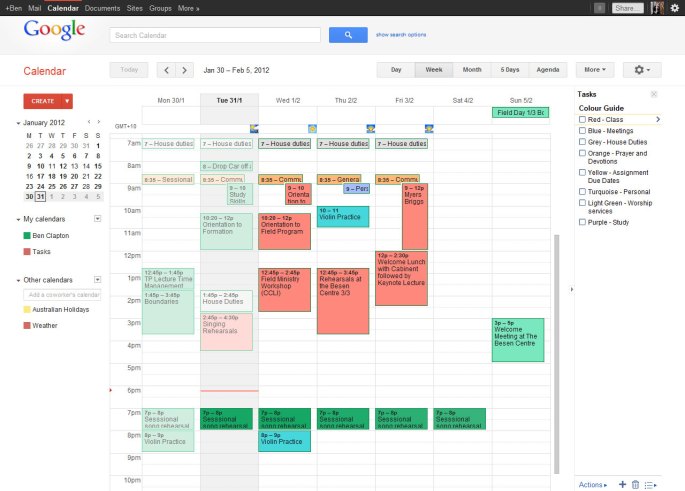
Brighten (and organise) your Google Calendar!

I’ve been in orientation this week for my course, and one of the lectures has been on time management. I’m really wanting to make sure I get organised and ensure that I make good use of my time (especially as there is often limited time), so I’m wanting to make full use of the resources available to me.

I’ve been using Google Calendar for a while now, which is especially awesome as it now sync’s with my phone. However, with everything looking the same, I longed for the ability to look at my week and quickly glance what was class time, what was study time, when assignments were due, and – importantly – when my “personal” time was – the time where I could go and practice my violin, play a game on my computer, or squeeze in a round of golf. Continue reading “Brighten (and organise) your Google Calendar!”

Well, I better have a Well-Being Plan

The Salvation Army Training College, Melbourne

I’ve practically finished my first week of orientation at the Training College. We’ve had a lot of different orientations – to uniform, to education, to prayer and more. Yesterday, we had a session called “Coping with Change”. We have all had to go through a big change in order to come to the Training College. At a very basic level, the shift from Perth to Melbourne was a big change. We were discussing yesterday the differences in language that we share – from Milk Bars and Delis, to Stobie Poles and Power Poles and even the way we pronounce Lego.

One thing we did was to create a well-being plan that focussed on some goals in four areas – Physical, Mental, Emotional and Spiritual. By setting goals in these four areas, we can help take control of certain areas of our life so that we can deal with the change better, but also be in a better mental state. Part of the exercise was to write down some names that we would share the plan with so that we can be accountable with it. So I’m going to share my goals with you, and post regularly on how I’m going. Continue reading “Well, I better have a Well-Being Plan”

Melbourne

Well, Liesl and I have arrived in Melbourne, and are slowly settling in, and realising that this is our home now. We’re staying at an Aunt’s place until Tuesday, so it still feels a bit like a holiday. However, we have done some things that make staying here very much a reality.
For example, one of the first things we did in Melbourne was to search for a new car. We sold our car in Perth, because we had a two door Hyundai Getz, and two door cars aren’t great when you’ve got a baby.

Continue reading “Melbourne”